


Moist fabric Fabric drying process BEI / cooling stage / in-situ
Chemistry, Plastics / Polymer
In-situ SEM observation of the fabric drying process using the Aqua Cover method. In a polyester/polyurethane (PEPU) blend knit fabric, moisture evaporated first from areas with the large gaps between the yarns. On the other hand, in the cotton woven fabric, moisture tended to evaporate over the entire surface of the fabric because there were fewer gaps between the yarns. In both cases, it can be observed that the moisture was still retained between the fibers even after the moisture between the yarns had evaporated. In addition, the images of the PEPU fabric showed no change in yarn width before and after evaporation, while the cotton woven fabric showed a slight change in yarn width.
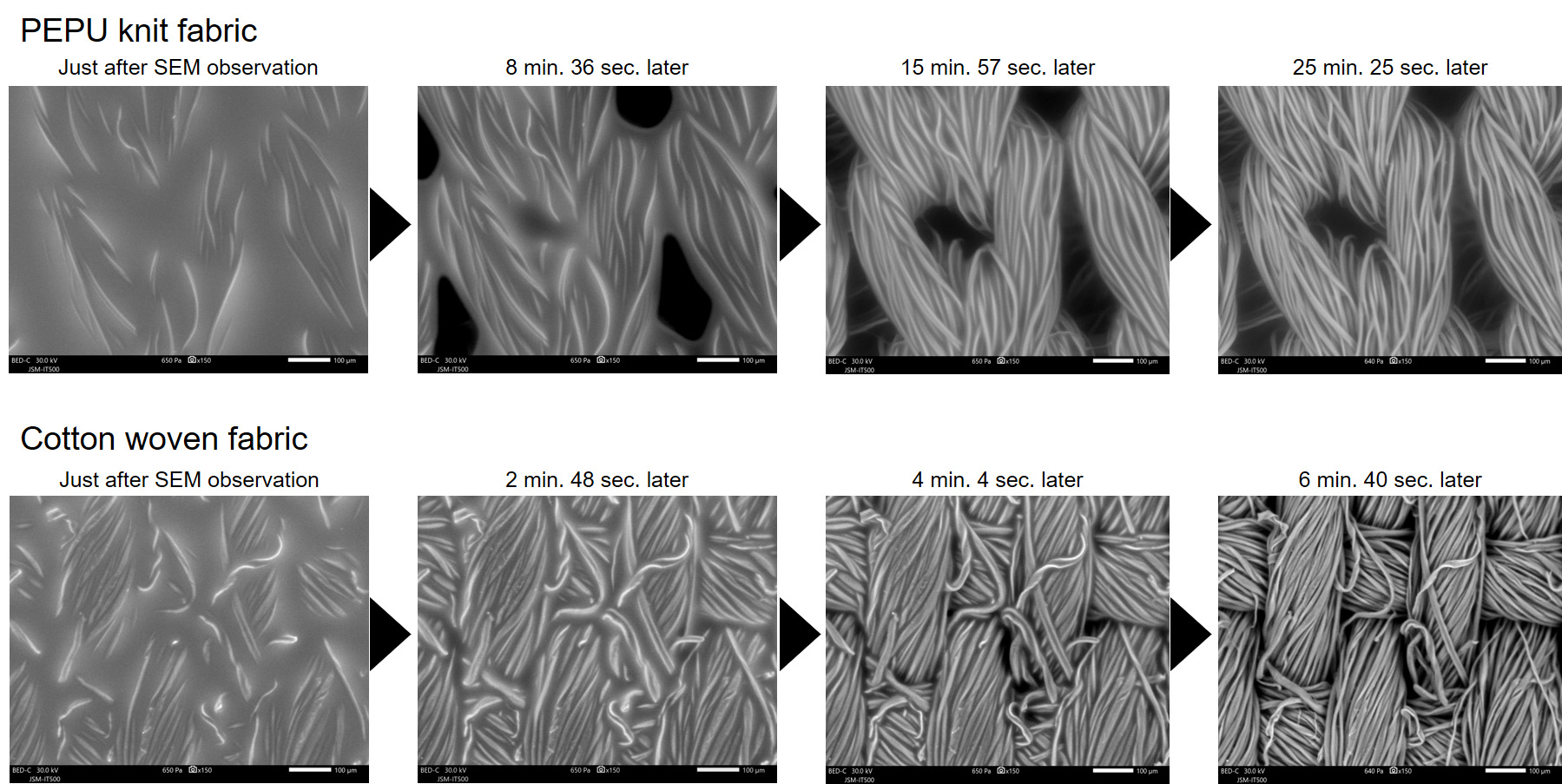
| Application | BEI / cooling stage / in-situ |
|---|---|
| Preprocessing | Aqua Cover method |
| Magnification | x150 |
| Shooting conditions | Acceleration voltage 30 kV, Low vacuum 650 Pa, BED-C, Working distance 7 mm, Temperature 0 ºC |
| Related information | Reference1) Inoue et al., Observation of wet specimens sensitive to evaporation using electron microscopy, Microscopy, 2018, 356-366. |
| Related product | JSM-IT510 InTouchScope™ Scanning Electron Microscope |
Related data


Are you a medical professional or personnel engaged in medical care?
No
Please be reminded that these pages are not intended to provide the general public with information about the products.