


MALDI-TOFMS, DART-TOFMS and NMR Application :
Comprehensive Analysis of Bimetallic Complexes
NM230003E
Transition metals have excellent catalytic properties because they have incompletely filled d-orbitals, which allow them to easily donate and accept electrons from other molecules. A general metal complex consists of a central metal atom or ion that is bonded to one or more ligands (Figure 1), whereas a bimetallic complex consists of two central metal atoms. Bimetallic transition metal complexes have unique properties and catalytic activity, therefore they have been garnering attention in the discovery of new transition metal catalysts and making catalytic processes more efficient. In the following, this application note explains the comprehensive analysis using JEOL mass spectrometer (MS) and nuclear magnetic resonance (NMR) spectrometer of monometallic and bimetallic complexes of acetylacetonate complexes.
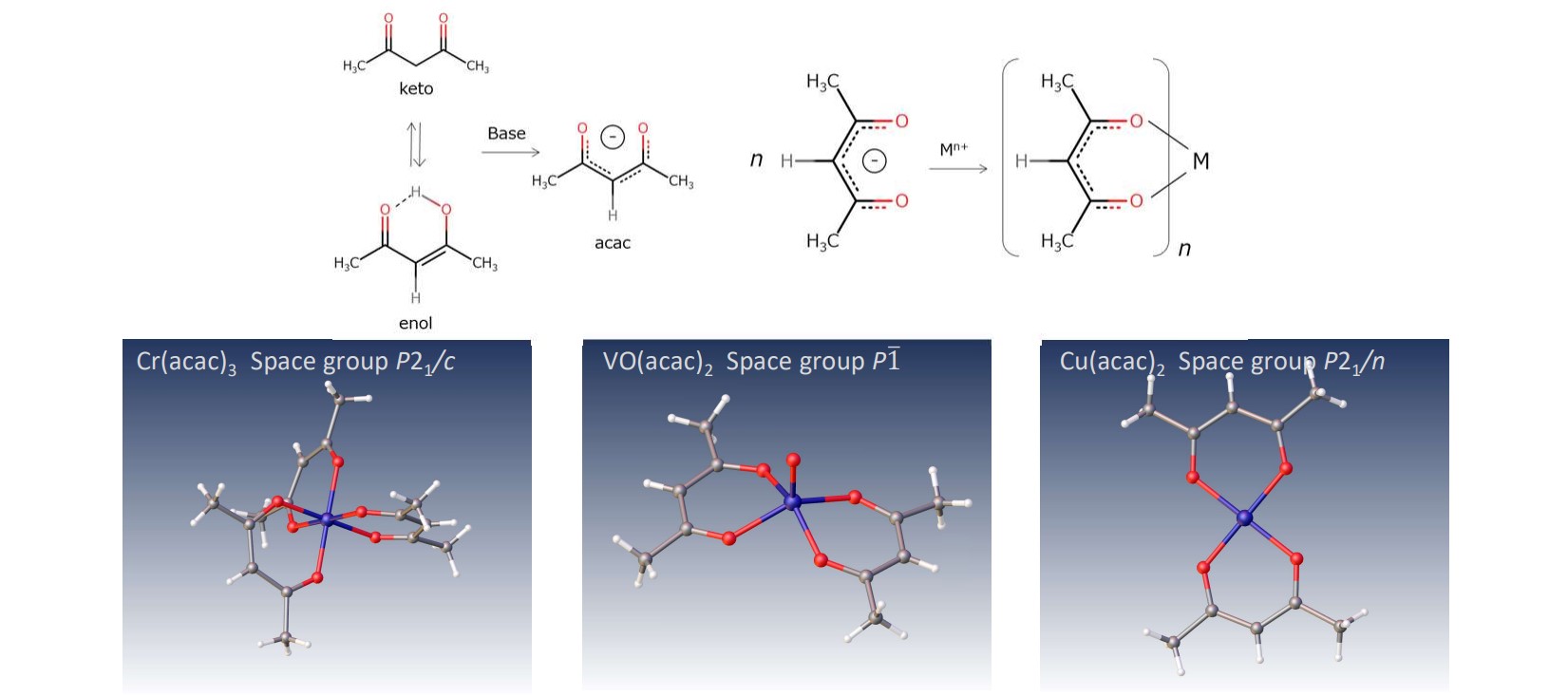
Figure 1. General acetylacetonate complexes, XtaLAB Synergy-ED
Comprehensive analysis with JEOL MS-NMR : Zinc (II) acetylacetonate
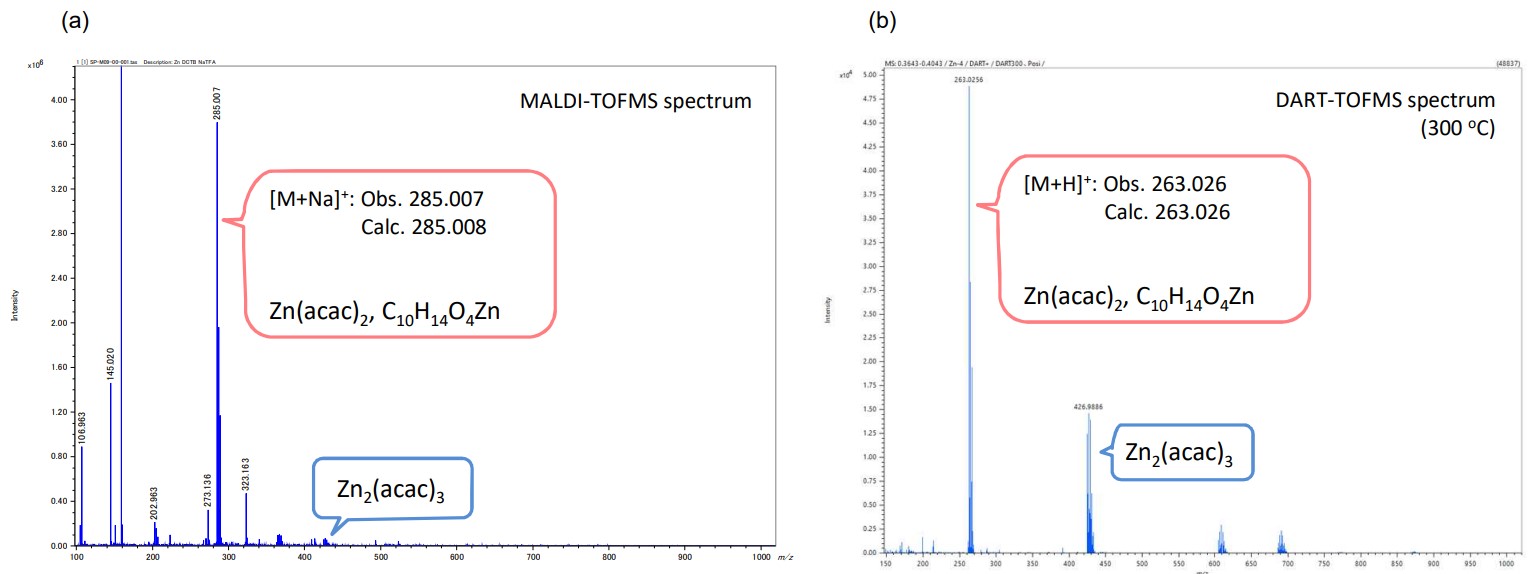
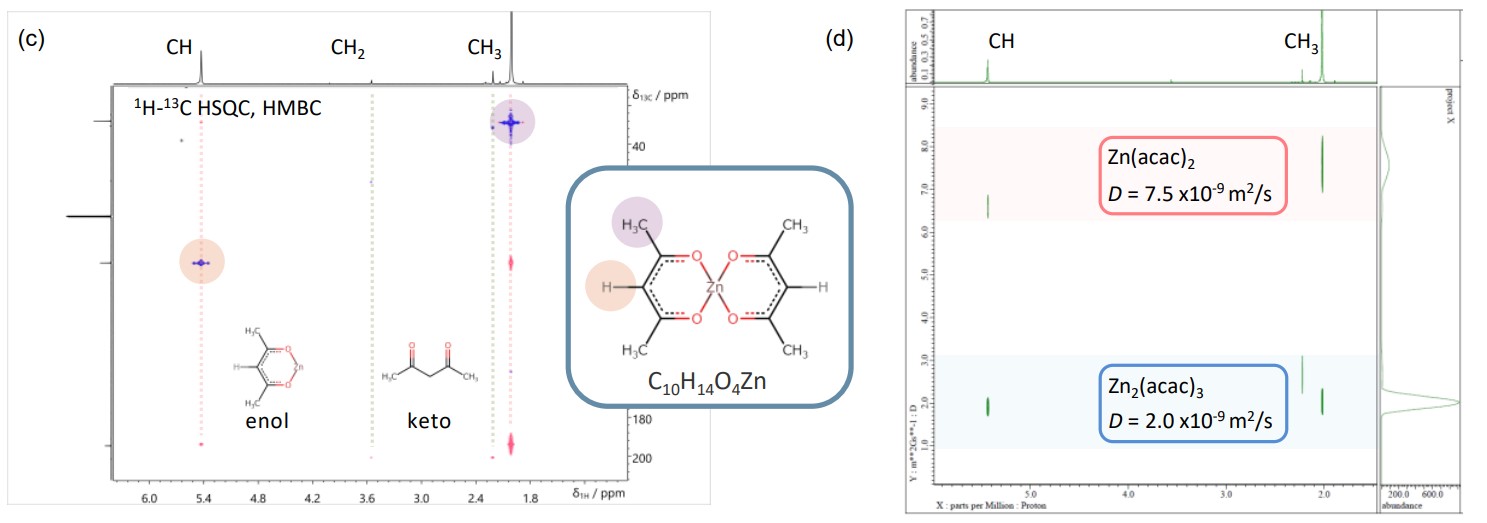
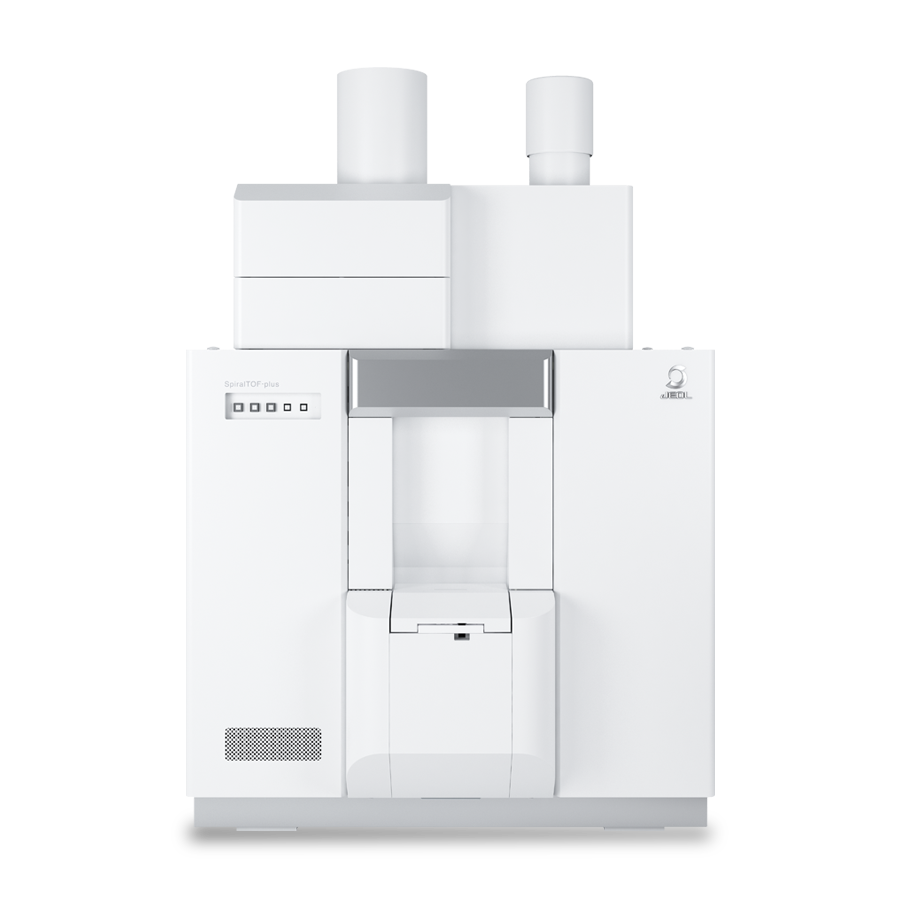
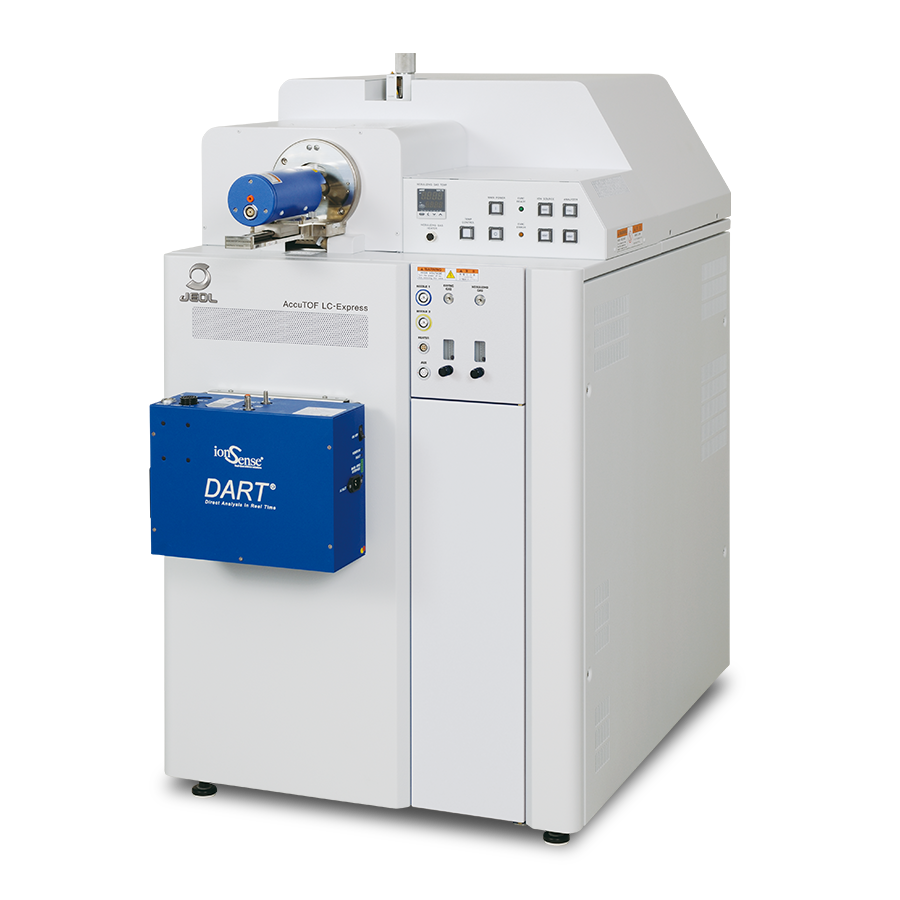
Figure 2. Comprehensive analysis of Zinc (II) acetylacetonate. (a) MS spectrum was measured using the JMS-S3000 SpiralTOF™-plus 2.0. (b) MS spectrum was measured using the JMS-T100LP AccuTOF™ LC-Express. (c) 1H-13C HSQC (blue) and HMBC (pink) in Chloroform-d were measured using JNM-ECZL 500R. (d) 1H DOSY spectrum.
Figure 2 shows the results of the comprehensive analysis of Zn(acac)2 complex, obtained from JMS-S3000 SpiralTOF™-plus 2.0, JMS-T100LP AccuTOF™ LC-Express and JNM-ECZL 500R. The molecular formula can be estimated by using the Mass spectra with MALDI-TOFMS (matrix-assisted laser desorption/ionization time-of-flight mass spectrometry) (Figure 2(a)) and DART™ (Direct Analysis in Real Time) (Figure 2(b)). Then it is possible to complementarily analyze the MS results with the 2D NMR data (Figure 2(c)). The MS-NMR results showed the accurate mass and the coordinate state of ligands of Zn(Ⅱ) monometallic complex, Zn(acac)2 (C10H14O4Zn). In addition, the NMR result indicated that both keto and enol forms are contained in the sample solution. In this condition, the keto form was measured to be approximately 2% of the main enol form. Furthermore, the MS results estimated that a bimetallic complex is contained. In NMR analysis, it is an effective method to analyze the NMR spectrum of the mixture with the self-diffusion coefficient of each compound. Such an analysis is called DOSY (Diffusion Ordered Spectroscopy). DOSY creates a two-dimensional plot where the chemical shift is measured along the horizontal axis, and along the vertical axis we show the self-diffusion coefficient (Figure 2(d)). Figure 2(d) showed the 2D DOSY peaks that correspond to the different components in the sample. The NMR DOSY result showed good consistency with the Zn2(acac)3 bimetallic complex estimated from the MS analysis.
Comprehensive analysis with JEOL MS-NMR : Rhodium (III) acetylacetonate
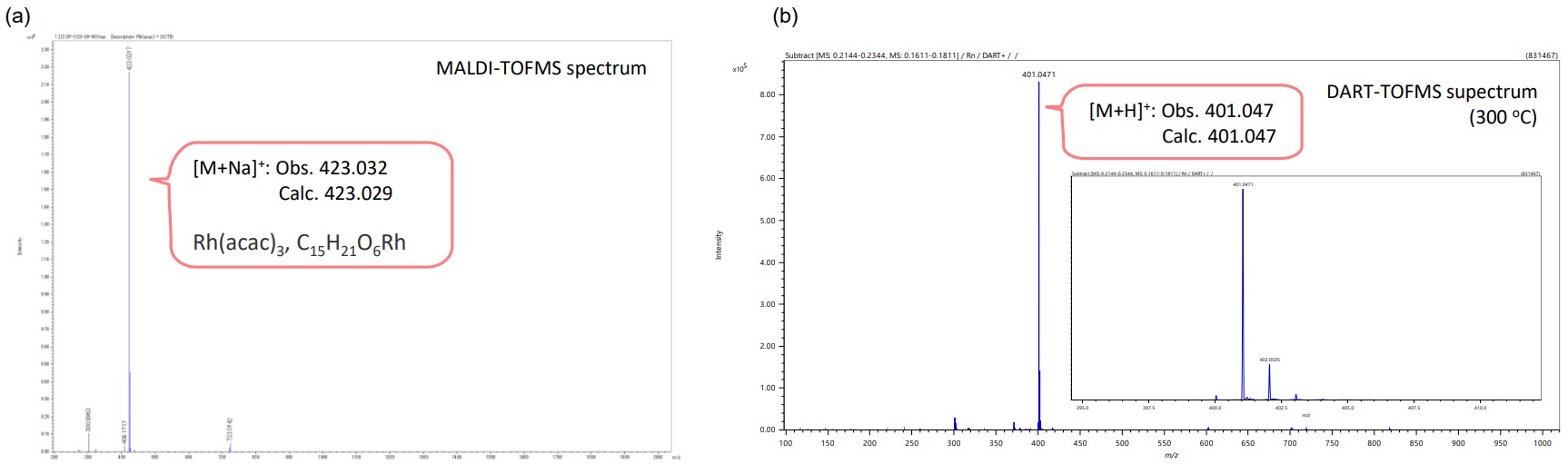
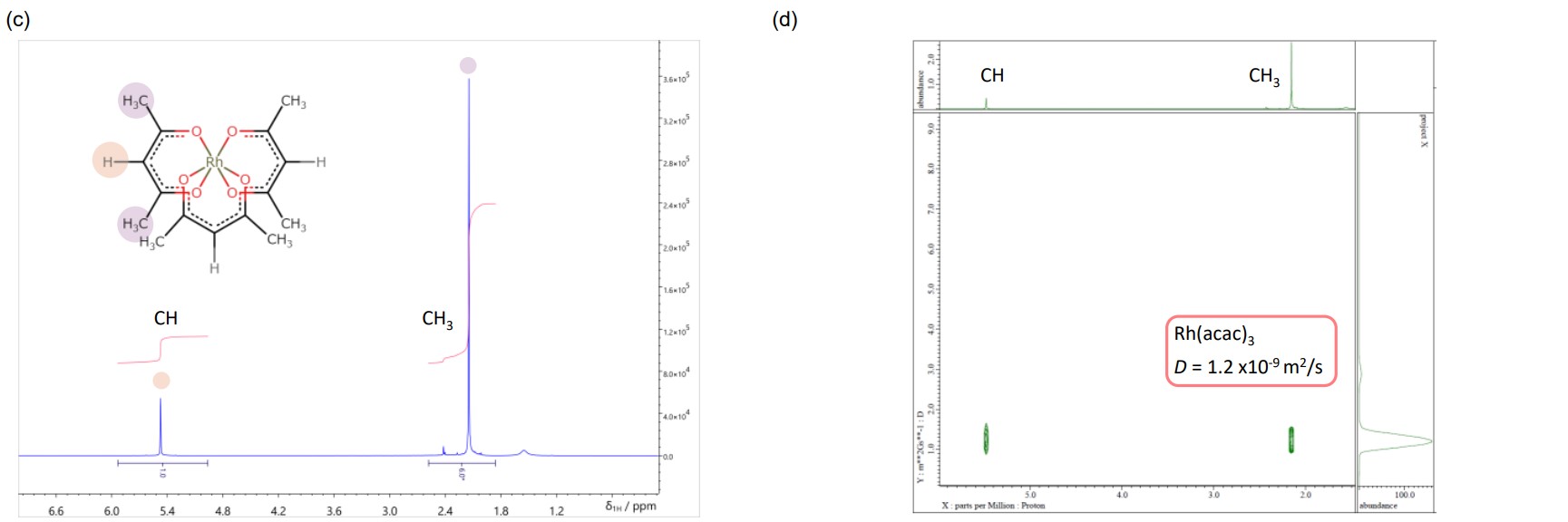
Figure 3. Comprehensive analysis of Rhodium (III) acetylacetonate. (a) MS spectrum was measured using the JMS-S3000 SpiralTOF™-plus 2.0. (b) MS spectrum was measured using the JMS-T100LP AccuTOF™ LC-Express. (c) 1H NMR spectrum in Chloroform-d was measured using JNM-ECZL 500R. (d) 1H DOSY spectrum.
Figure 3 shows the results of the comprehensive analysis of Rh(acac)3 complex, obtained from MALDI-TOFMS, DART™ and NMR. In Figure 3 (a) and (b), as opposed to Zinc (II) acetylacetonate from Figure 2, the accurate mass of Rh(Ⅲ) monometallic complex, Rh(acac)3 (C15H21O6Rh) was observed only. In Figure 3(d), the NMR DOSY result did not show any peak corresponding to the different self-diffusion coefficients. In conclusion, the NMR DOSY result showed the same conclusion as the MS analysis.
Conclusion
In this application note, we reported the comprehensive analysis using MALDI-TOFMS, DART-TOFMS and NMR of monometallic and bimetallic complexes, specifically Zn(acac)2 and Rh(acac)3 of the acetylacetonate complexes. It is possible to complementarily analyze the molecular structure estimated from the MS result by using NMR data. Furthermore, the comprehensive analysis of MS and NMR DOSY is a quite effective method for elucidating the molecular structure of bimetallic complexes.
Solutions by field
Related products



Are you a medical professional or personnel engaged in medical care?
No
Please be reminded that these pages are not intended to provide the general public with information about the products.