


off-axial geometrical aberration
off-axial geometrical aberration
The geometrical aberrations (departures of the path of electron beams from the path of ideal imaging on the image plane) are expressed as a function of r (distance of the electron beam from the optical axis) and α (opening angle between the electron beam and the optical axis). Among those aberrations, aberrations which depend on r, are called the off-axial geometrical aberrations (hereinafter, referred to be “off-axial aberrations”). The off-axial aberrations also include aberrations which depend on both r and α. It should be noted that the aberrations depending only on the opening angle α are called the axial geometrical aberrations (hereinafter, referred to be “axial aberrations”.
The off-axial aberrations often seen by users are “distortion” and “curvature of image field”. The former causes the distortion of an image (Fig. 1a), and the latter causes a blur towards the periphery of the image (Fig. 1b). The off-axial aberrations are serious when observing a large field of view (approx. 10 μm × 10 μm or more) at a low magnification, i.e. the observation field is well distant from the optical axis. Off-axis aberrations have a significant effect on image degradation (distortion and blurring) at the lower part of the imaging lens system, i.e. the intermediate lens and the projection lens. This is because the more the image is magnified by the lenses, the greater the distance r at the periphery of the magnified image (Fig. 2).
The off-axis aberrations include “Distortion” (proportional to r3), “curvature of image field” (proportional to r2α), “off-axial astigmatism” (proportional to r2α) and off-axial coma aberration (proportional to rα2), which are four aberrations in “Five Seidel aberrations” unavoidable in the optical principle. Furthermore, the magnetic-field lens of an electron microscope rotates the image, producing “S-shaped distortion” (proportional to r3) where the image rotates at the periphery of the field of view. On the other hands, the effect of the “parasitic” off-axial aberrations is small and those aberrations do not cause practical problems.
The imaging system consists of several magnetic field lenses, and the directions of the off-axis aberrations caused by each lens depend on the excitation condition of the lens. Thus, the imaging system can be designed in such a way that the off-axial aberrations of the constituent lenses cancel out to each other.
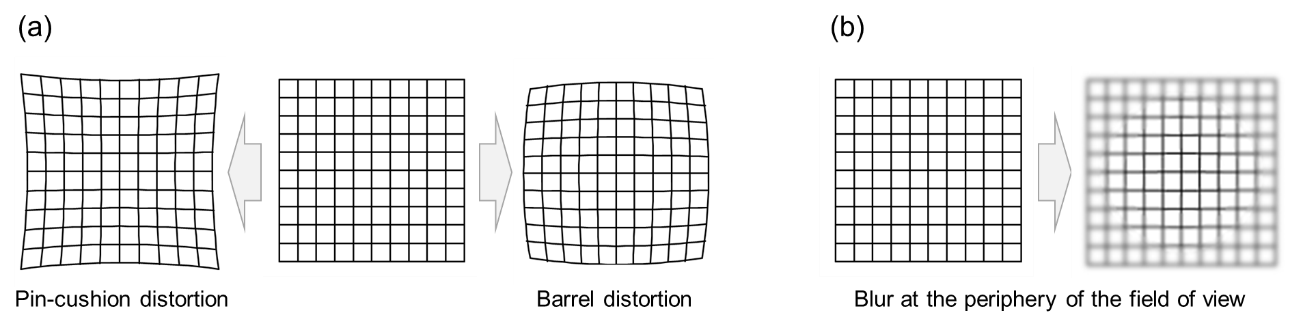
Fig. 1. Examples of the off-axial geometrical aberrations. (a) Distortion (r3), (b) Curvature of image field (r2α)
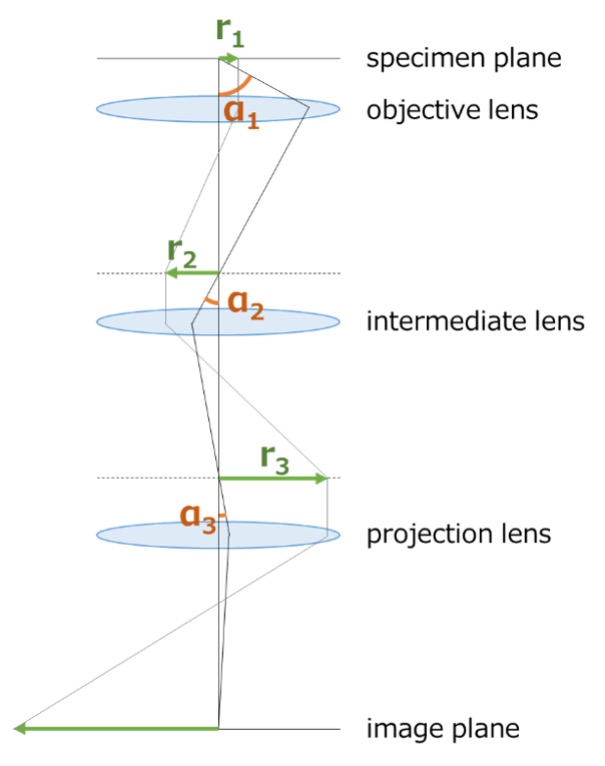
Fig. 2. The change in distance r from the optical axis and the opening angle α between the electron beam and the optical axis when the image is magnified by several lenses of the imaging system. The more the image is magnified, the greater the distance (r1 < r2 < r3) and to the contrary, the smaller the angle α (α1 > α2 > α3). Since the off-axis aberrations depend on the distance r from the optical axis, the aberrations of the lower lenses (projection lens rather than intermediate lens) have more effects on degradation of the image.
Related Term(s)
Term(s) with "off-axial geometrical aberration" in the description


Are you a medical professional or personnel engaged in medical care?
No
Please be reminded that these pages are not intended to provide the general public with information about the products.