


rocking curve
rocking curve
A “rocking curve” means the change in diffraction intensity as a function of the change of diffraction condition (excitation error). It usually refers to the intensity profile obtained when the incident beam direction is changed around the Bragg condition.
For a very thin specimen, the rocking curve is interpreted by the kinematical diffraction theory. For a specimen thicker than a few nanometers, the rocking curve suffers the dynamical diffraction effect (multiple diffraction effect). Thus, the rocking curve usually observed is explained by the dynamical diffraction theory and a purely kinematical rocking curve is rarely observed. Such a rocking curve can be observed in a convergent-beam electron diffraction (CBED) pattern.
Fig. 1 shows a rocking curve of a diffracted (reflected) wave calculated by the kinematical diffraction theory (a), and that calculated by the two-wave dynamical diffraction theory (b). In the case of kinematical diffraction, the magnitude of the principal maximum increases proportional to the square of the thickness t, and the width of the principal maximum decreases proportional to the reciprocal of t. The subsidiary maxima rapidly decrease with increasing thickness. At a thickness of a few nm or more, the magnitude of the subsidiary maxima can be neglected. Thus, only the principal maximum is observed in the rocking curve.
On the other hand, in dynamical diffraction, even if thickness increases, the magnitude of the principal maximum remains at a certain (finite) value. The magnitude and angular broadening of the subsidiary maxima are changed along the envelope shown in Fig. 1(b). The width of the envelope is proportional to the reciprocal of the extinction distance ξg. As is seen in Fig. 1(b), the diffraction intensity does not necessarily take the maximum value at the position of the exact Bragg condition.
Fig. 2(a) shows a rocking curve of the 220 reflection of Si taken by the CBED method. This shows a good agreement with the calculated rocking curve (Fig. 1(b)). It is noted that black lines observed in the peripheral of the figure are due to the other reflections excited.
Fig. 2(b) shows a CBED pattern of the 000 transmitted wave taken at the [100] zone axis incidence. In this figure, two rocking curves are seen in the orthogonal two directions which originate from the orthogonal 220 and 220 reflections. In addition, it is confirmed from the figure that a Si crystal has a four-fold rotational symmetry with respect to the [100] axis.
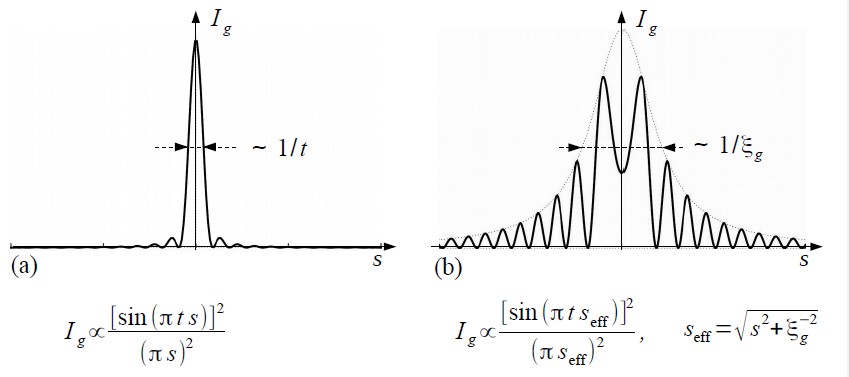
Fig. 1 (a) Rocking curve of a diffracted wave due to kinematical diffraction. (b) Rocking curve of a diffracted wave due to dynamical diffraction. The symbols t, s, and ξg respectively stand for specimen thickness, deviation parameter (excitation error) from a Bragg condition, and extinction distance. The intensity equations of the diffracted wave which are obtained respectively by kinematical diffraction and dynamical diffraction, are given under the figures (a) and (b). (reprinted from M. Tanaka, M. Terauchi, K. Tsuda, “Introduction to Electron Diffraction and Elementary Crystallography” (in Japanese), Kyoritsu Printing Co., Ltd., 2014)
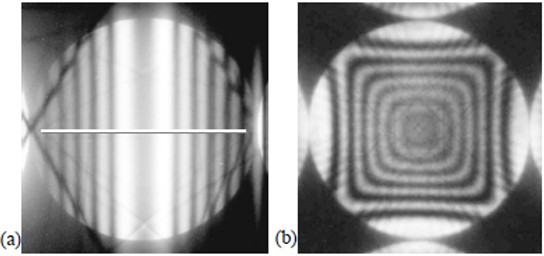
Fig. 2 (a) Rocking curve of the 220 reflection of Si taken under the two-wave approximation condition. The intensity curve traced along the center horizontal line agrees well with the curve shown in Fig. 1(b). The obliquely running dark lines seen at the periphery originate from the other reflections. (b) CBED pattern of the 000 transmitted wave taken at the [100] zone axis incidence. Two orthogonal rocking curves are seen in the vertical and horizontal directions. A four-fold rotational symmetry is clearly seen. (reprinted from M. Tanaka, M. Terauchi, K. Tsuda, “Introduction to Electron Diffraction and Elementary Crystallography” (in Japanese), Kyoritsu Printing Co., Ltd., 2014)
Related Term(s)
Term(s) with "rocking curve" in the description


Are you a medical professional or personnel engaged in medical care?
No
Please be reminded that these pages are not intended to provide the general public with information about the products.