


Identification of pigment by Direct Insertion Probe(DIP)-MS/MS
MSTips No. 409
Introduction
Pigment used in painting and printing cannot be measured by GC-MS, because they cannot be dissolved in solvent. Therefore, direct analysis using Direct Insertion Probe (DIP)-MS is suitable for pigment analysis. However, since column separation by GC is not possible in direct analysis, other components are detected along with the pigment component. As a result, mass spectrum is complex. Thus, it is difficult to accurately understand the pigment component included in the product. Alternatively, DIP-MS/MS can obtain mass spectrum from specific ion, so it is possible to confirm pigment component from product ion scan measurement. In this application note, we report on the analysis of pigment component in polymer by using DIP-MS/MS.
Measurement
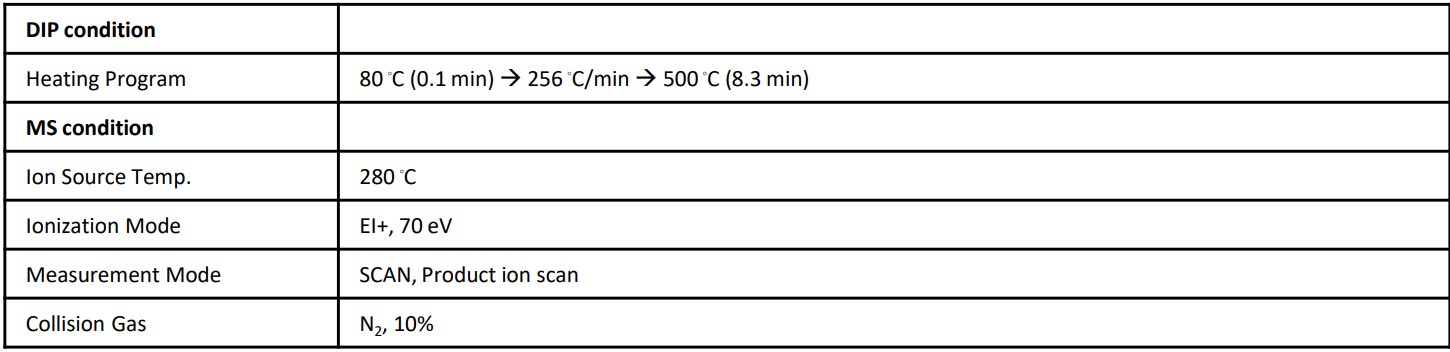
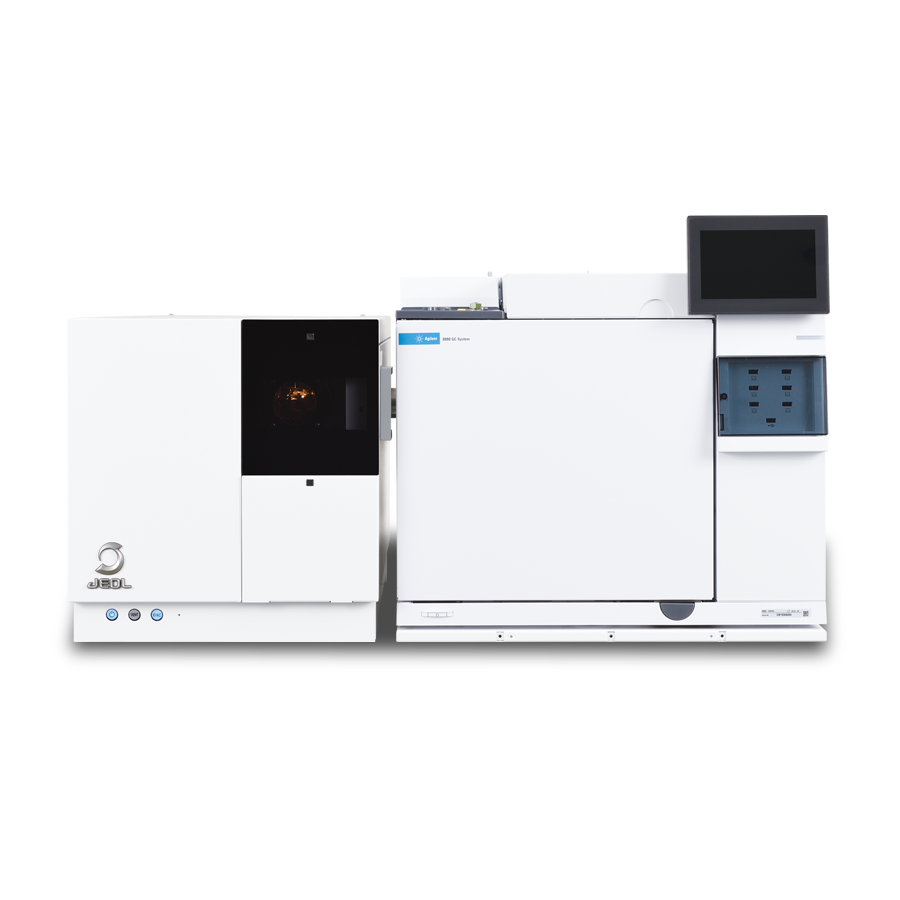
The measurement was performed using DIP and GC triple quadrupole mass spectrometer JMS-TQ4000GC UltraQuad™ TQ. The sample was a polypropylene (PP) plastic storage container that had been frozen and ground to a powder, and copper phthalocyanine was added. The measurement were performed under the measurement condition shown in Table 1.
Table 1 Measurement condition.
Result
・Measurement result by DIP-MS
The NIST library data is shown in Fig. 1 (a), the mass spectrum of copper phthalocyanine is shown in Fig. 1 (b), and the mass spectrum of the measured sample is shown in Fig. 1 (c). When only copper phthalocyanine is measured, the result is similar to the NIST library data, and it can be confirmed that the sample is copper phthalocyanine. On the other hand, in the measured sample, although the peak at m/z 575 that is estimated to be copper phthalocyanine is observed, it is not clear due to the effect of the pyrolyzate from PP.
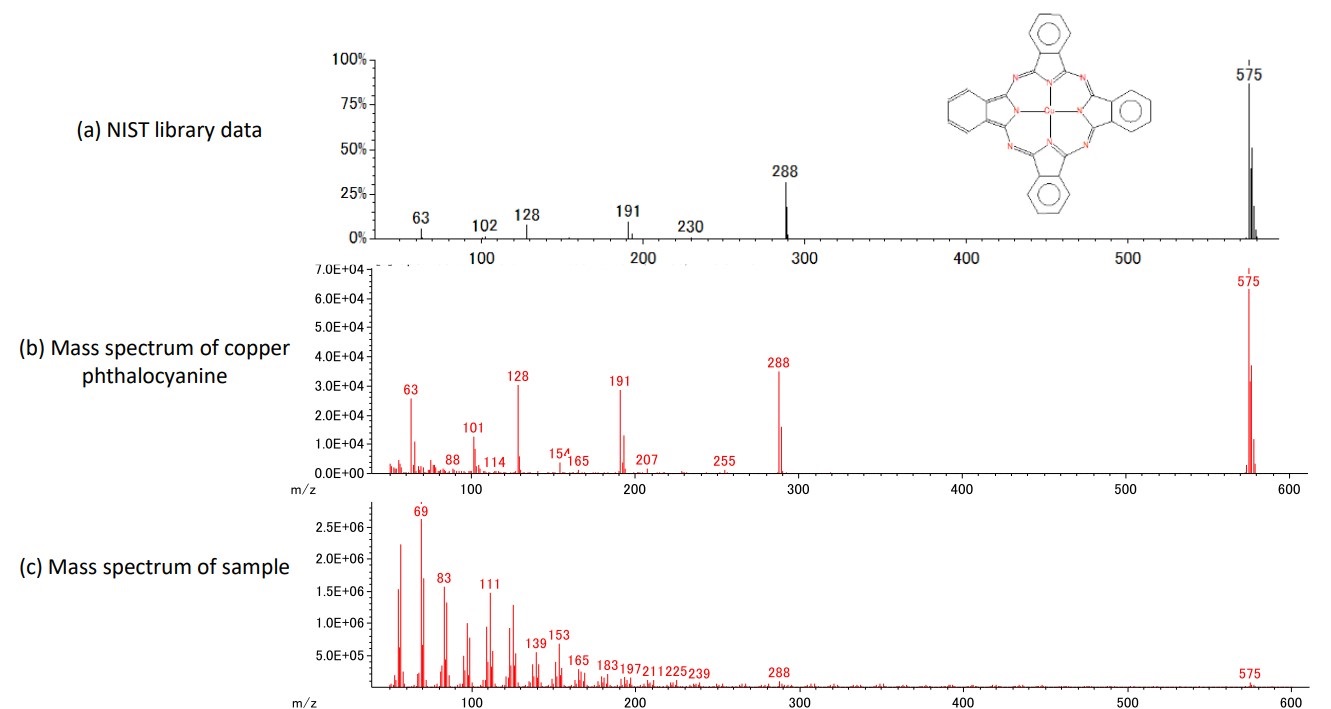
Fig. 1 Comparison NIST library data (a), mass spectrum of copper phthalocyanine (b) with mass spectrum of sample (c).
・Measurement result by DIP-MS/MS
The product ion spectra obtained from product ion scan measurement using m/z 575 as the precursor ion is shown in Fig. 2. The product ion spectra obtained from the measured sample by collision energy at 10 eV and 40 eV are similar to those obtained from copper phthalocyanine. According to these results, it can be confirmed that measured sample contain copper phthalocyanine. Also, as showed in the results at 10 eV and 40 eV, similar product ion spectra can be obtained if the collision energy is the same. In other words, the obtained product ion spectra can be registered in a private library for analysis by library search. Furthermore, the obtained product ion spectra by MS/MS measurement contain structural information. As shown in Fig. 3 (d), cleavage occurs mainly at heteroatoms and coordinate bond.
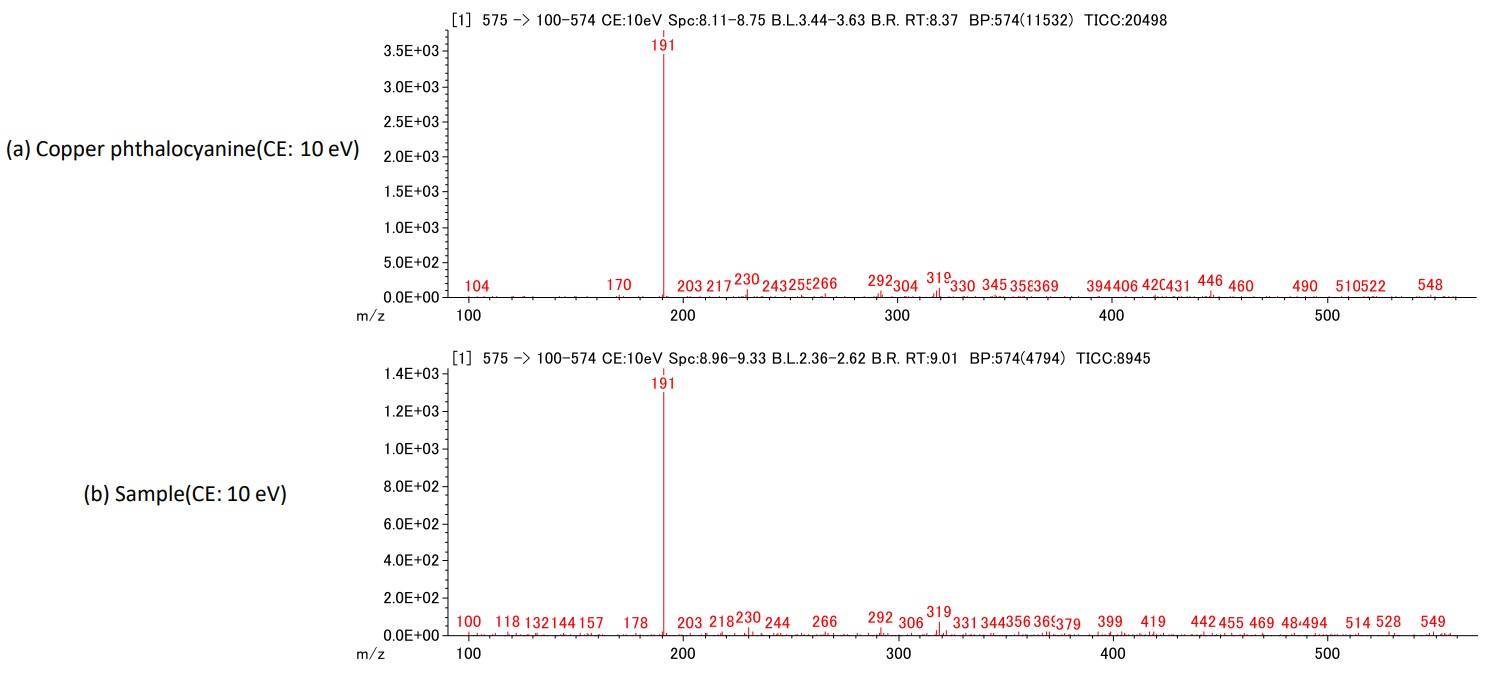
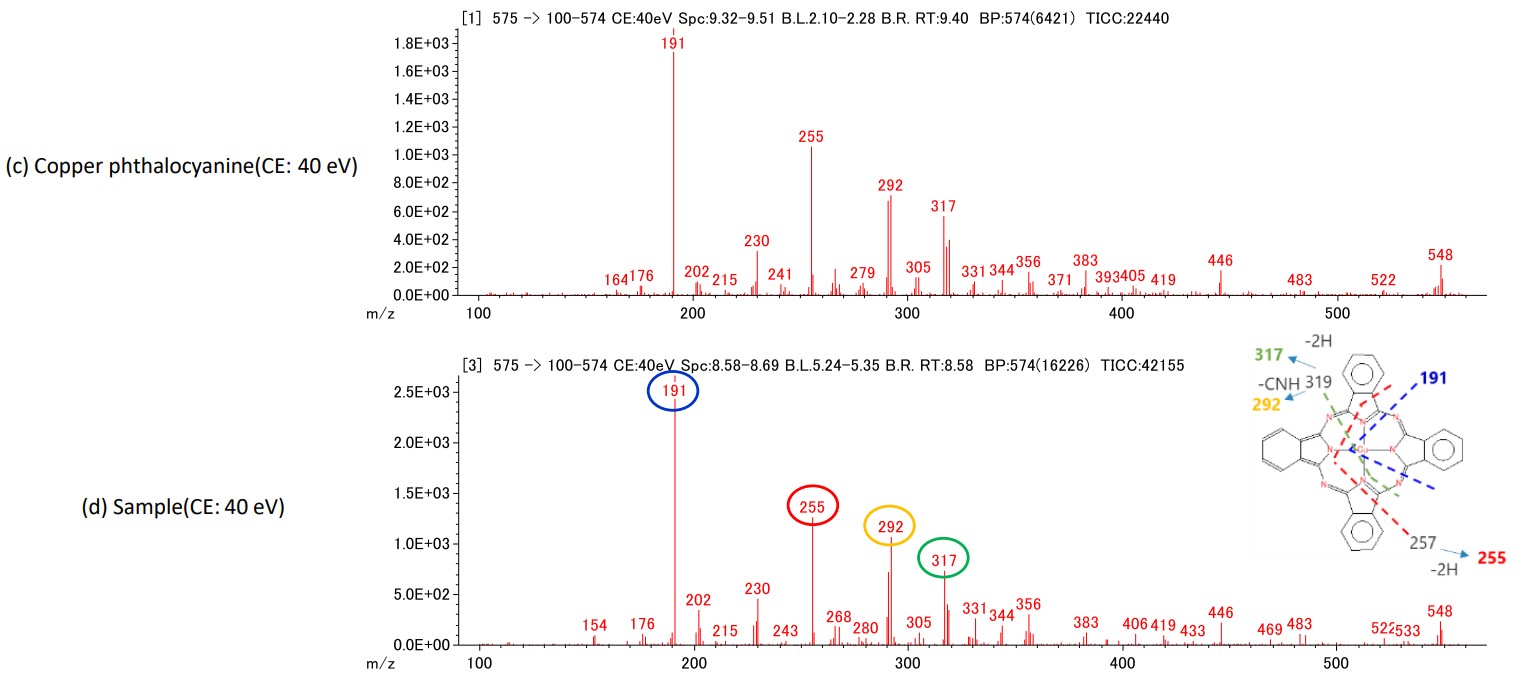
Fig. 3 Product ion spectra of copper phthalocyanine(CE: 10eV) (a), sample(CE: 10eV) (b), copper phthalocyanine(CE: 40eV) (c), sample(CE: 40 eV) (d) .
Conclusion
It is difficult to confirm the target component among matrix components by using DIP-MS, but in case of DIP-MS/MS, specific ion can be selected and MS/MS measurement can be performed, so it is possible to confirm whether the target component is contained by comparing product ion spectra. Furthermore, the product ion spectrum obtained from MS/MS measurement is useful for structural analysis, because it contains structural information.
Solutions by field
Related products


Are you a medical professional or personnel engaged in medical care?
No
Please be reminded that these pages are not intended to provide the general public with information about the products.