


Solid-State Half-Integer Quadrupolar NMR ④ DFS & RAPT
NM240004E
Signal enhancement by manipulating the ST
In half-integer quadrupolar nuclei NMR, it is common to selectively excite and observe the CT (Central Transition), but further sensitivity enhancement can be expected by inverting or saturating the polarization of the ST (Satellite Transitions) before exciting the CT. Fig. 1 shows an example of manipulating the polarization of the ST for an I = 3/2 nucleus. There are four energy levels, and a schematic distribution of the population is shown, where more population is distributed in the lower energy levels. Here, it is assumed that there are 2, 4, 6, and 8 circles distributed from the higher energy level. If the CT is observed as is, sensitivity equivalent to (4-2=) 2 circles will be obtained. At this point, if the population of the ST is inverted, the population will be redistributed as 4, 2, 8, and 6 circles from the higher energy level, and observing the CT will result in sensitivity equivalent to (8-2=) 6 circles. Alternatively, if the population is saturated, the distribution becomes 3, 3, 7, and 7 circles, and observing the CT in this case results in sensitivity equivalent to (7-3=) 4 circles. In this way, inverting or saturating the polarization of the ST is expected to enhance the sensitivity of the CT. Generally, for I = n/2 nuclei, the theoretical sensitivity enhancement is n+1/2 times when the ST is saturated, and 2n times when it is inverted. However, due to hardware limitations, it is difficult to uniformly excite the broad ST, and ideal sensitivity enhancement cannot be achieved except under special conditions such as when using single-crystal samples.
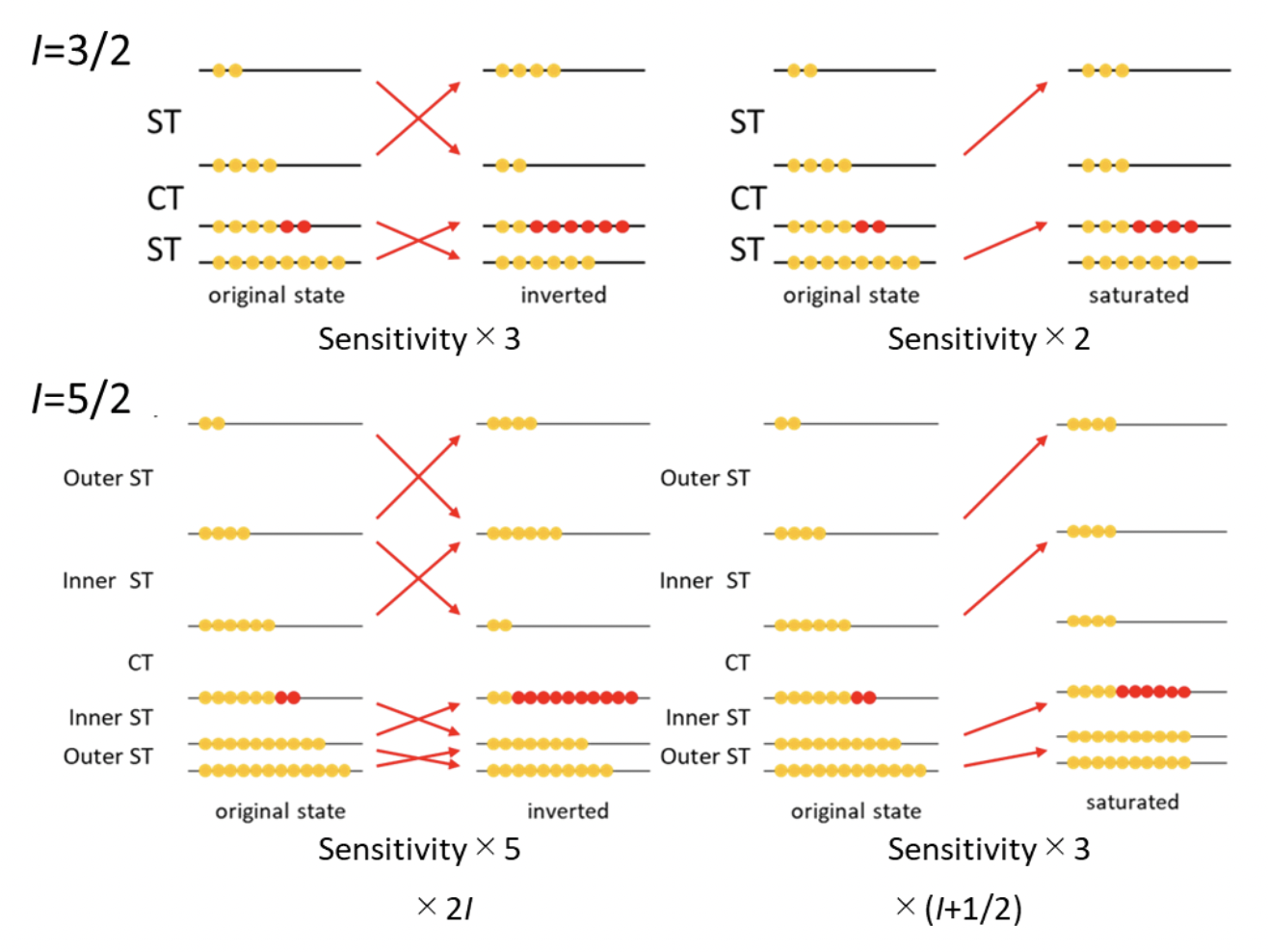
Figure 1 | A schematic diagram of CT sensitivity enhancement through ST manipulation: Sensitivity enhancement of the CT can be expected by inverting or saturating the ST for an I = 3/2 nucleus (top), and for an I = 5/2 nucleus (bottom).
DFS, RAPT
In actual measurements, RAPT (Rotor Assisted Population Transfer) is used for saturation, and DFS (Double Frequency Sweep) is used for inversion (Fig. 2). RAPT saturates the ST by applying pulses with different phases at regular intervals. DFS inverts a wide range of ST by applying cosine-wave radiofrequency pulses and sweeping the frequency. Unlike DFS, RAPT does not sweep the frequency, but the sample rotation achieves a state that mimics frequency sweeping. While DFS can be applied to stationary samples, RAPT does not significantly enhance sensitivity when used with stationary samples.
Fig. 2 shows the spectra of 87Rb in RbNO3 obtained using a single pulse, as well as the sensitivity-enhanced spectra using DFS and RAPT. It can be seen that both DFS and RAPT achieve approximately 2.5 times the sensitivity of a normal single pulse. Ideally, DFS should provide 3 times the sensitivity and RAPT should provide 2 times, but it is assumed that the state achieved lies between complete inversion and complete saturation in both methods.
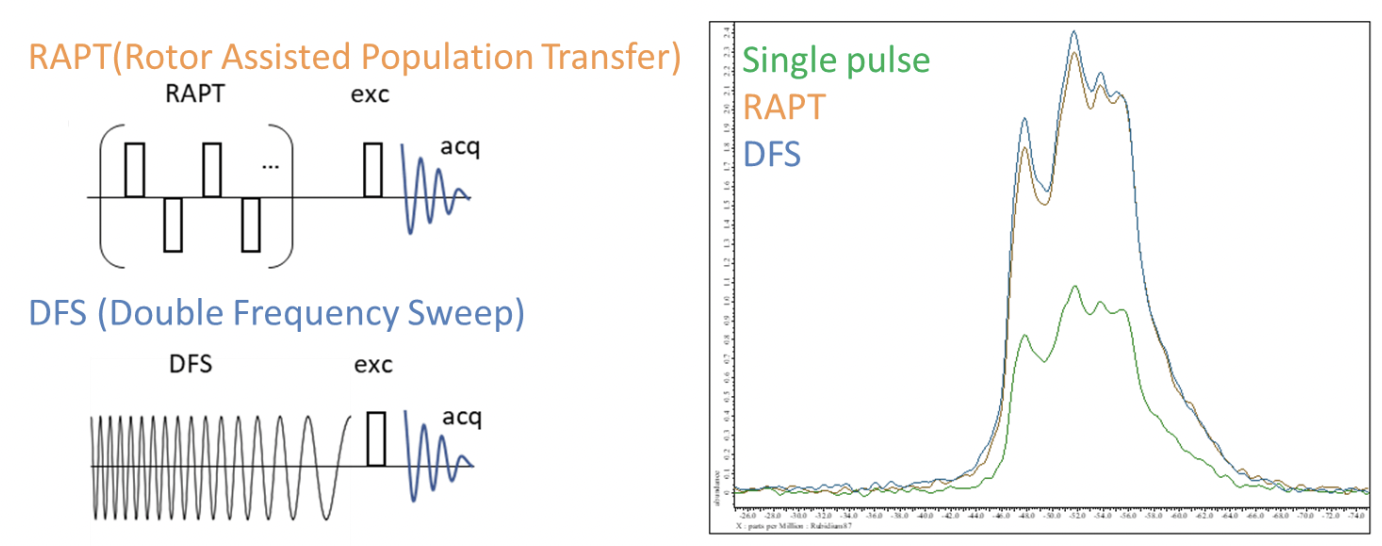
Figure 2 | Comparison of the RAPT Sequence, DFS Sequence, and 87Rb Single Pulse Spectrum of RbNO3. Sensitivity enhancement of approximately 2.5 times is achieved with RAPT or DFS.
DFS-CPMG, RAPT-CPMG
By combining CPMG introduced in NM240003E with either DFS or RAPT, further sensitivity enhancement is expected. Figure 3 shows the sequences and the 87Rb single pulse, DFS-CPMG, and RAPT-CPMG spectra of RbNO3. Both methods achieve an approximate sensitivity enhancement of 4.5 times.
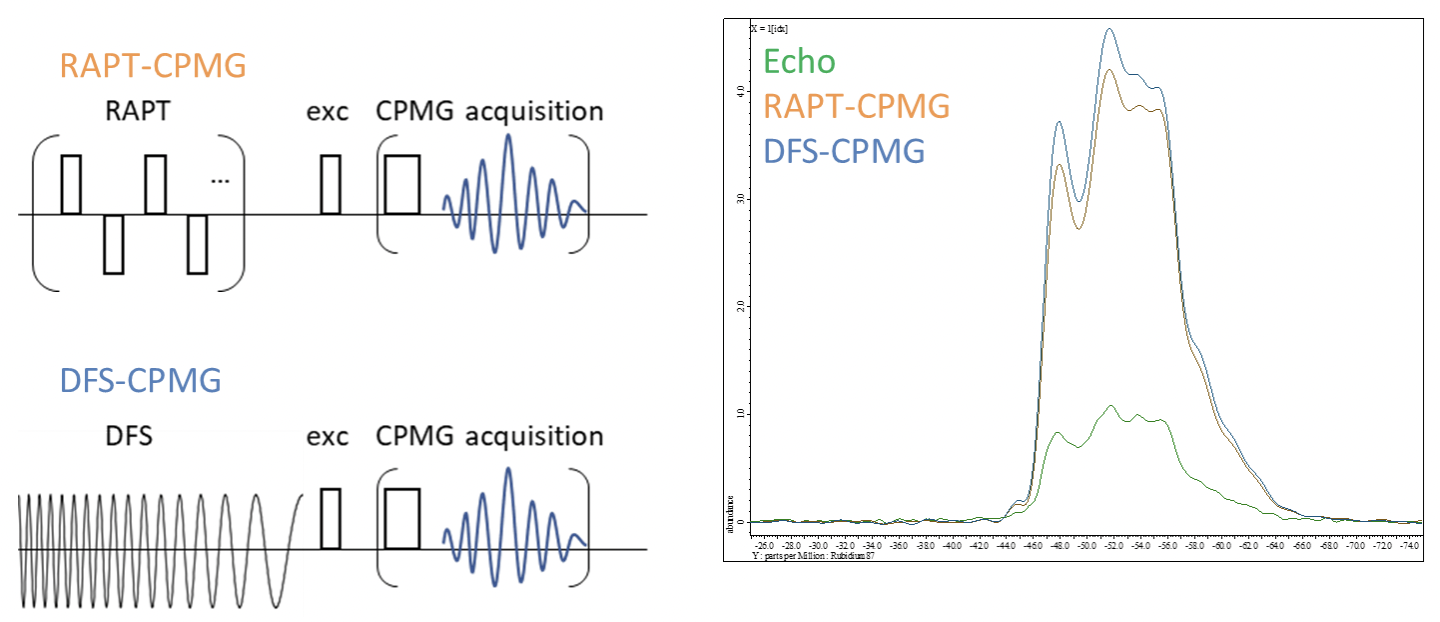
Figure 3 | Pulse sequences of RAPT-CPMG and DFS-CPMG (left). Comparison of the 87Rb single pulse spectrum of RbNO3 with the RAPT-CPMG/DFS-CPMG spectra (right). In this sample, a sensitivity enhancement of approximately 4.5 times for echo measurements is achieved using either RAPT-CPMG or DFS-CPMG.
Reference
DFS: Kentgens, A. P. M. & Verhagen, R., Chem Phys Lett 300, 435–443 (1999).
RAPT: Yao, Z., Kwak, H. T., Sakellariou, D., Emsley, L. & Grandinetti, P. J., Chem Phys Lett 327, 85–90 (2000).
Related products


Are you a medical professional or personnel engaged in medical care?
No
Please be reminded that these pages are not intended to provide the general public with information about the products.