


Artifact reduction in pure shift NMR by SAPPHIRE technique
NM220003E
Pure shift NMR spectroscopy, also known as homonuclear broadband decoupling, offers a significant advancement in NMR analysis. While conventional 1H NMR spectra provide valuable information including chemical shift, splitting patterns, coupling constants, and intensity, they often suffer from complexity due to signal overlap. Pure shift NMR techniques effectively suppress homonuclear 1H-1H interactions, collapsing multiplets into singlets and thereby minimizing signal overlap. This makes it particularly advantageous for analyzing complex molecules and mixtures. In pure shift NMR, a series of Free Induction Decay (FID) blocks, typically spanning several tens of milliseconds, are acquired. These blocks are then combined to produce a single FID (as illustrated in Fig. 1) which is subsequently Fourier transformed.
However, it's important to note that in pure shift NMR spectra, periodic sidebands occur due to discontinuities in the FID. These sidebands, with a period inversely proportional to the length of the FID block, can complicate analysis for certain samples (refer to Fig. 2).

Fig. 1: Acquiring and processing pure shift NMR data
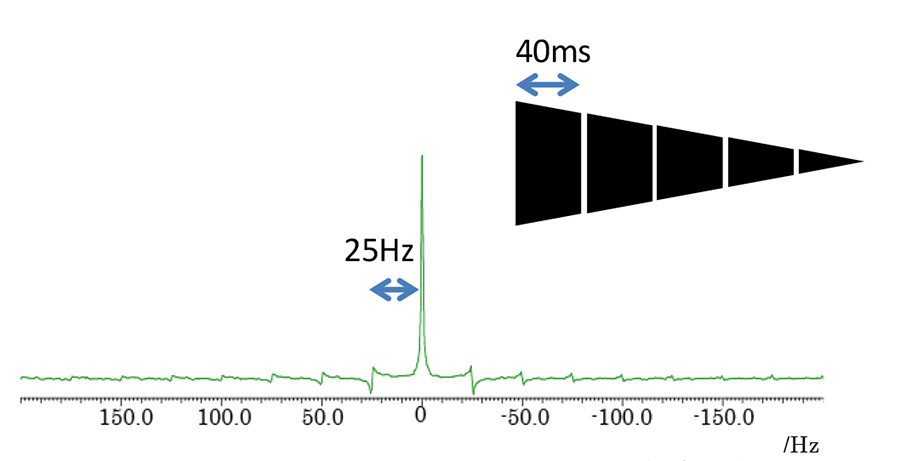
Fig. 2: Sideband in pure shift NMR spectra
SAPPHIRE
The SAPPHIRE (Sideband Averaging by Periodic PHase Incrementation of Residual J Evolution) technique1 reduces the periodic sidebands and yields clean pure shift spectra. The SAPPHIRE method suppresses the sidebands by collecting and averaging FID blocks of slightly different length before they are combined. SAPPHIRE pulse programs and data processing algorithms have been part of Delta NMR software since V.6.1. The SAPPHIRE approach aids in identifying small signals that may be obscured by larger sidebands and enables the observation of 1H-19F couplings that are typically challenging to discern amidst 1H-1H couplings. As illustrated in Fig. 3, the SAPPHIRE method effectively suppresses sidebands and enhances the lineshape of signals.
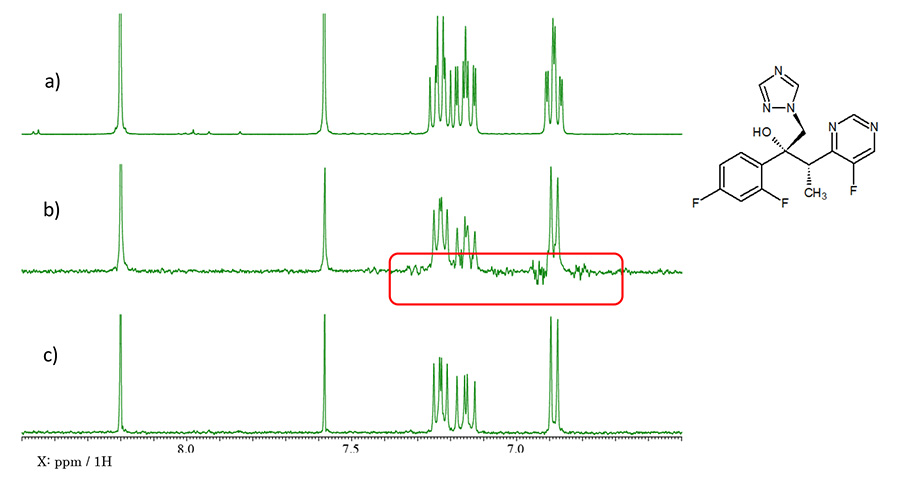
Fig. 3: a) 1H NMR, b) standard PSYCHE, c) PSYCHE SAPPHIRE spectra of Voriconazole.
Reference :
1 Chem. Commun. 2017, 53, 10188-10191
Solutions by field
Related products


Are you a medical professional or personnel engaged in medical care?
No
Please be reminded that these pages are not intended to provide the general public with information about the products.