


An attempt at end-group analysis of polycarbonates up to 100,000 molecular weight using SEC preparative separation and NewSpiralTOF™
MSTips No. 527
Matrix-assisted laser desorption/ionization time-of-flight mass spectrometry (MALDI-TOFMS) is a powerful tool for characterizing synthetic polymers, including confirming molecular weight distribution and estimating end group composition, because it can detect monovalent ions over a wide mass range. However, in the analysis of polymers with high polydispersity, "mass discrimination," where ionic intensity decreases in the high molecular weight range, is a challenge. To overcome this challenge, it is known that fractionating polymers according to molecular weight using size exclusion chromatography (SEC) to reduce polydispersity before measurement with MALDI-TOFMS is effective. Generally, low-resolution linear TOF is often used for measuring synthetic polymers with molecular weights exceeding 10,000, but its low mass accuracy makes it unsuitable for end group composition estimation. In this report, we attempted end group analysis using high-precision MALDI-TOFMS after SEC fractionation of polycarbonate (PC) with high polydispersity.
Experiment
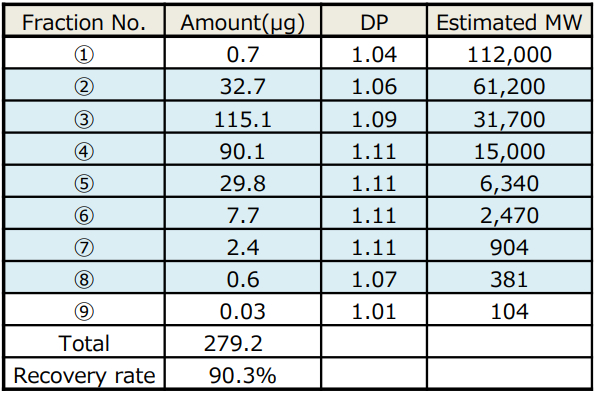
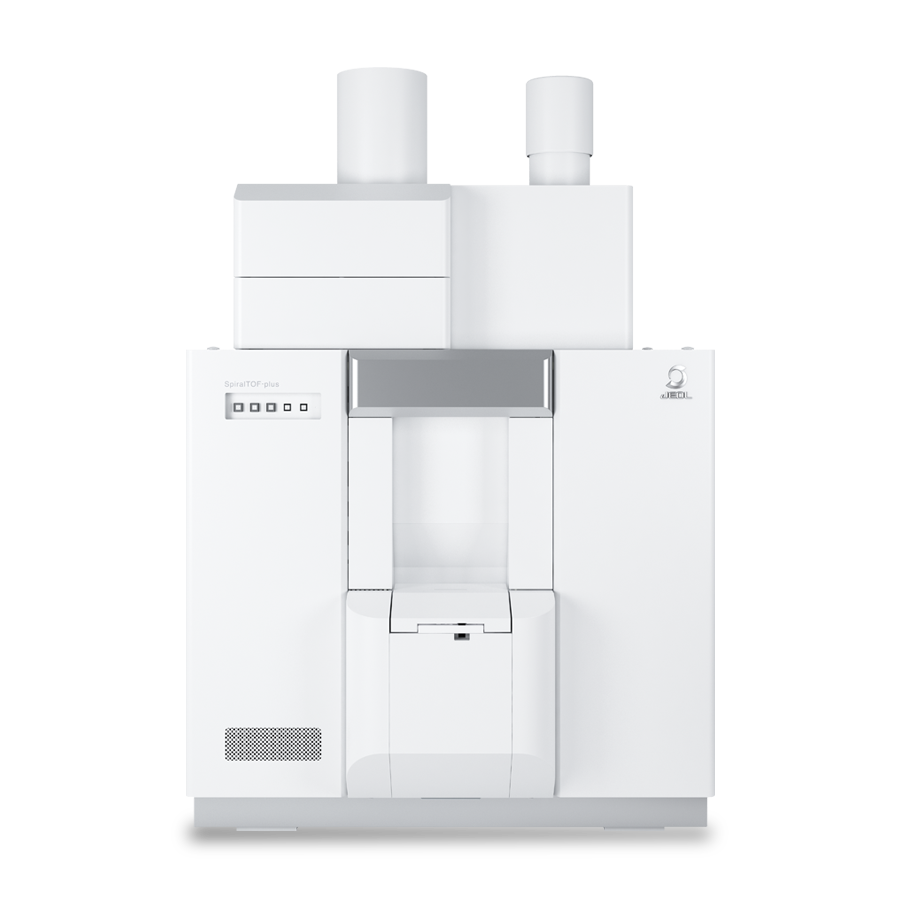
10 mg of polycarbonate synthesized by the phosgene method was dissolved in 5 mL of chloroform. The sample was fractionated for MALDI-TOFMS using the SEC and fractionation apparatus shown in Figure 1 under the conditions in Table 1. This fractionation apparatus allows fractionation while atomizing with heated nitrogen gas. Since the solvent evaporates simultaneously with fractionation, it is easy to increase the sample volume by fractionating multiple samples in the same cup. The SEC chromatogram and the sample volume, polydispersity, and estimated absolute molecular weight for each fraction are shown in Figure 2 and Table 2. A high recovery rate of approximately 90% was achieved using this SEC fractionation apparatus. Fractions ② to ⑧, with a polydispersity of approximately 1.1, were subjected to MALDI-TOFMS measurement. For MALDI-TOFMS sample preparation, 1 µL and 10 µL of the fractionation solution (prepared by adding 10 µL of chloroform to a metal cup) and the matrix solution (DCTB) were mixed and dropped onto a 1 µL plate for drying. The cationizing agent solution (NaTFA) was pre-dropped onto the plate and dried. Measurements were then performed using the Spiral positive ion mode of the JMS-S3000 “NewSpiralTOF™”.
Table 1 Fractionation conditions
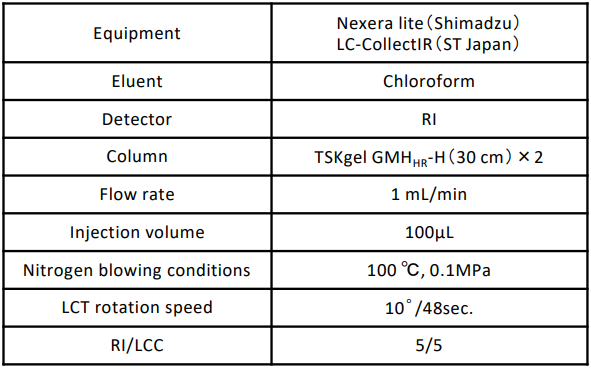
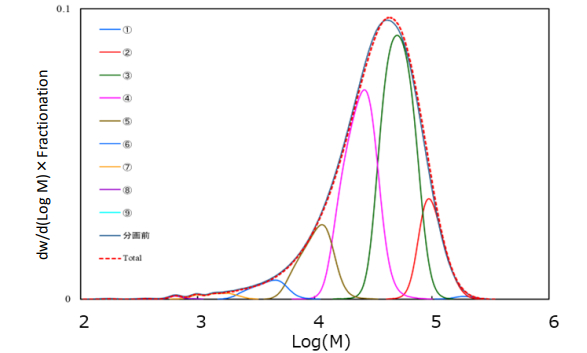
Figure 2 SEC Chromatogram
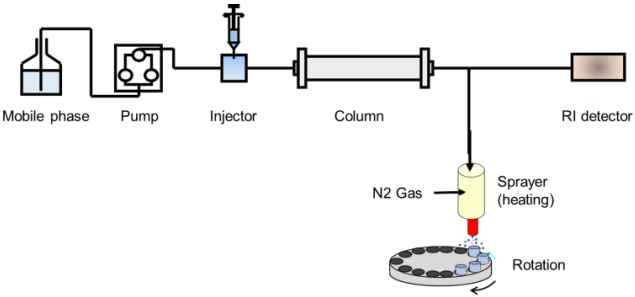
Figure 1
Fractionation device
Table 2 Fractionation result
Result
Figure 3 shows the mass spectra of fractions ② to ⑧. Good mass spectra were obtained by fractionating PC with high polydispersity using an SEC fractionation apparatus. Enlarged views of the isotopic patterns in each mass range, which are important for estimating end group composition, are also shown. Since monoisotopic peaks could be observed with sufficient ionic intensity up to approximately m/z 5000, end group analysis was performed in that region using precise mass. Figure 4 shows the mass spectra of fractions ⑥ to ⑧. End group analysis was performed using precise mass, and the green arrows were estimated to represent cyclic oligomers, while the blue/light blue arrows were estimated to represent the structures shown in the figure. These two series were observed as the main series up to a molecular weight of 80,000.
Conclusion
By combining the SEC fractionation system with NewSpiralTOF™, efficient fractionation was possible for measuring samples with high polydispersity using MALDI-TOFMS. Changes in the isotopic pattern across each mass range were confirmed, and corresponding high-precision mass accuracy was investigated.
Acknowledgment
We would like to express our sincere gratitude to TOSOH Analysis and Research Center Co., Ltd. and S.T. Japan Inc. for providing the SEC fractionation samples.
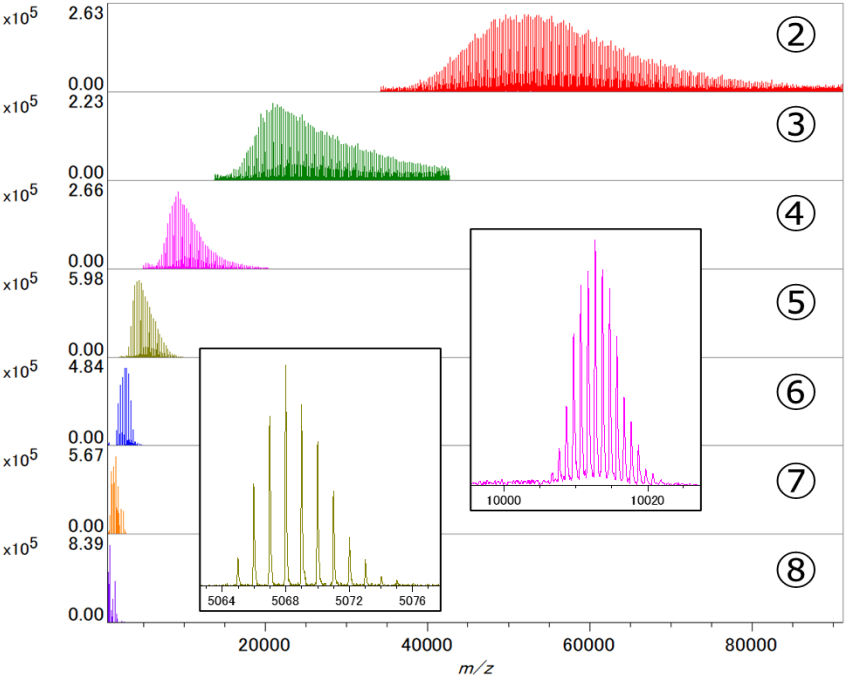
Figure 3 Mass spectrum of each fraction
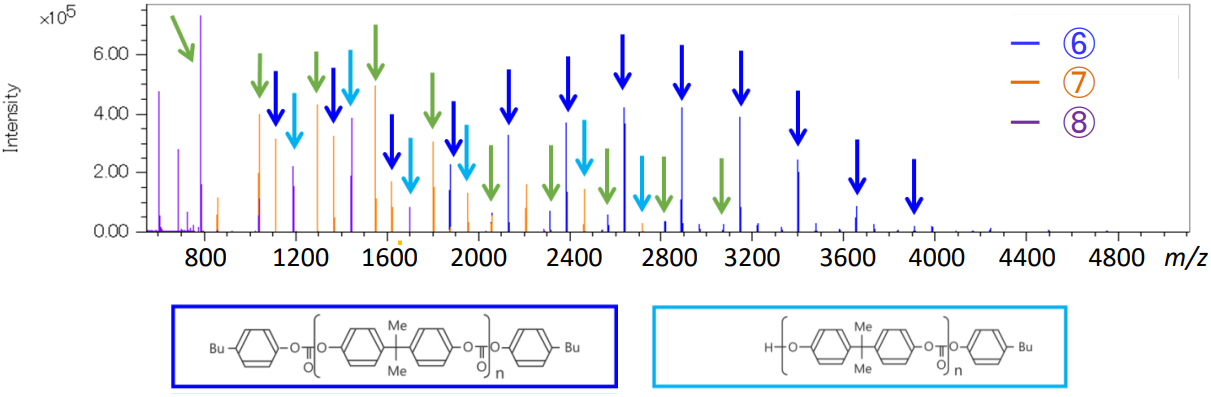
Figure 4 Mass spectra of fraction ⑥~⑧ and estimated end-groups
Solutions by field
Electrical / Electronic Component
Related products


Are you a medical professional or personnel engaged in medical care?
No
Please be reminded that these pages are not intended to provide the general public with information about the products.