


Operando‐analysis of organic photovoltaic devices via ESR and EDMR methods
ER260006
Characteristics and issues in organic photovoltaic devices
Organic photovoltaic devices (OPVs, see Fig. 1(a)) are light, thin, and cost-effective. Furthermore, OPVs have many unique properties which conventional inorganic semiconductor cannot achieve. Therefore, they are attracting considerable attention as next-generation renewable energy devices[1]. The most important issues that inhibit commercialization are durability and stability (see Fig. 1(b)). To explore the origin of degradation in OPVs, precise analysis is needed on the view points in molecular scope.
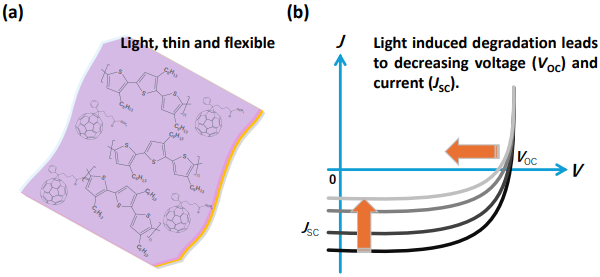
Fig. 1 (a) Schematic drawing of an OPV (b) Conceptual picture of J-V curves revealing light induced degradation of an OPV
ESR and EDMR
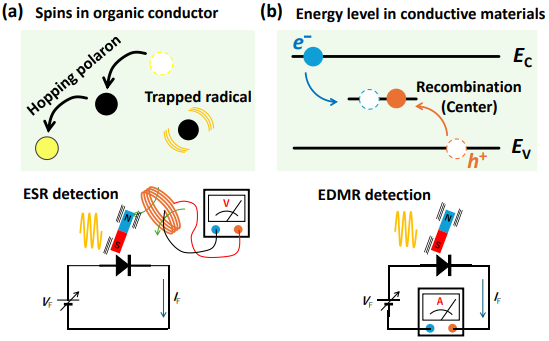
Fig. 2 (a) Targets and principle of ESR measurement and (b) of EDMR
Organic semiconductor devices are generally evaluated by analyzing physical properties associated with trapped radicals and current paths through recombination centers derived from detected polarons, which act as charge carriers in organic conductors. Such microscopic analysis can extract information about behaviors at the molecular level, while a macroscopic J-V measurement, as shown in Fig. 1(b), cannot access it. As shown in Fig. 2(a), Electron Spin Resonance (ESR) method is a useful technique which can detect polarons and trapped radicals as a change of magnetic moments, sensitively and selectively. In contrast, Electrically Detected Magnetic Resonance (EDMR, as shown in Fig. 2(b)) can selectively detect electron spins related to recombination currents, which are associated with device performance.
Operando-ESR and EDMR
The observed OPV using blended P3HT:PC61BM film as an active layer improves the efficiency of electron transport due to the insertion of a thin LiF layer between the active layer and the Al electrode. It is well known that post-annealing of this device, which is an essential manufacturing process, induces significant performance degradation[2]. As shown in Fig. 3(a), this ESR spectrum reveals PC61BM anion radicals generated at the interface between PC61BM and a LiF / Al electrode via a chemical reaction. It is considered that these anions act as charge-scattering centers. In contrast, the EDMR spectrum of the same device, as shown in Fig. 3(b), reveals a newly found current path through different paramagnetic species, which are identified as P3HT polarons acting as recombination centers. These two spectra imply that different spins contribute to different mechanisms of device performance degradation [3, 4].
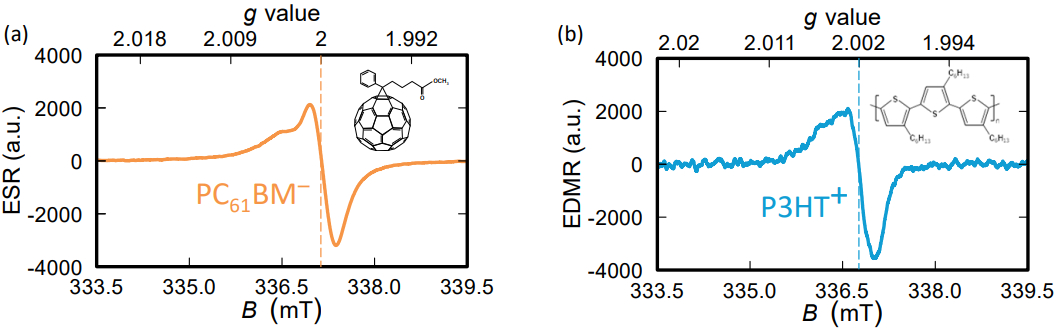
Fig. 3 (a) ESR spectrum of a post-annealed OPV (b) EDMR spectrum of the same OPV
Both spectra were measured under DC bias conditions.
References
[1] L. Ding, Organic Solar Cells: Materials Design, Technology and Commercialization (Wiley, 2022). [2] F. Li, J. Zhao, K. Yao, and Y. Chen, Chem. Phys. Lett. 553, 36 (2012). [3] D. Liu et al., Appl. Phys. Lett. 104, 243903 (2014). [4] T. Suzuki and K. Marumoto, J. Appl. Phys. 135, 075002 (2024).
Solutions by field


Are you a medical professional or personnel engaged in medical care?
No
Please be reminded that these pages are not intended to provide the general public with information about the products.