


Temperature dependence and line width of ESR signal from chromium(III)
ER200003E
ESR signal of chromium(III)
Chromium (III) oxide has been used for cement, rubber, roofing materials, ceramics, etc. Recently, a unique characteristic has been utilized in the development of memories. At room temperature, chromium (III) oxide does not exhibit an ESR signal. However, an ESR signal becomes noticeable around g = 1.98 when the temperature reaches 200°C (refer to Figure 1). Chromium (III) oxide behaves as an antiferromagnet at room temperature, and physical properties undergo a phase transition to a paramagnetic state at elevated temperatures. The temperature at which this phenomenon occurs is the phase transition temperature TN (Néel temperature).

Figure 1. ESR signal of chromium (Ⅲ)
Temperature dependence of ESR signal
ESR measurements were conducted within the temperature range of 33 to 200 °C, facilitated by a variable temperature controller (ES-13060DVT5). Figure 2(A) shows that the vertical axis represents the integral value of the ESR signal, while the horizontal axis represents temperature. The integral value exhibited a progressive increase as the temperature advanced from the phase transition point, denoted as TN (approximately 34 °C). The value reached its zenith at around 40 °C. The maximum paramagnetic susceptibility is attained at approximately 40°C. Figure 2(B) shows the vertical axis now depicts the linewidth of the ESR signal (A in Figure 1), while the horizontal axis corresponds to temperature. The ESR signals were measured within the range of 34-35°C, in increments of 0.1°C. Consequently, the linewidth of the signal exhibited continuous variations at these temperatures. Upon surpassing 40°C, linewidth of the ESR signal became at an average of 46 ± 1 mT, and thereafter, no substantial alterations in linewidth were noted with changing temperature. This phenomenon has been reported to be observed in the vicinity of the phase transition temperature, TN[1].
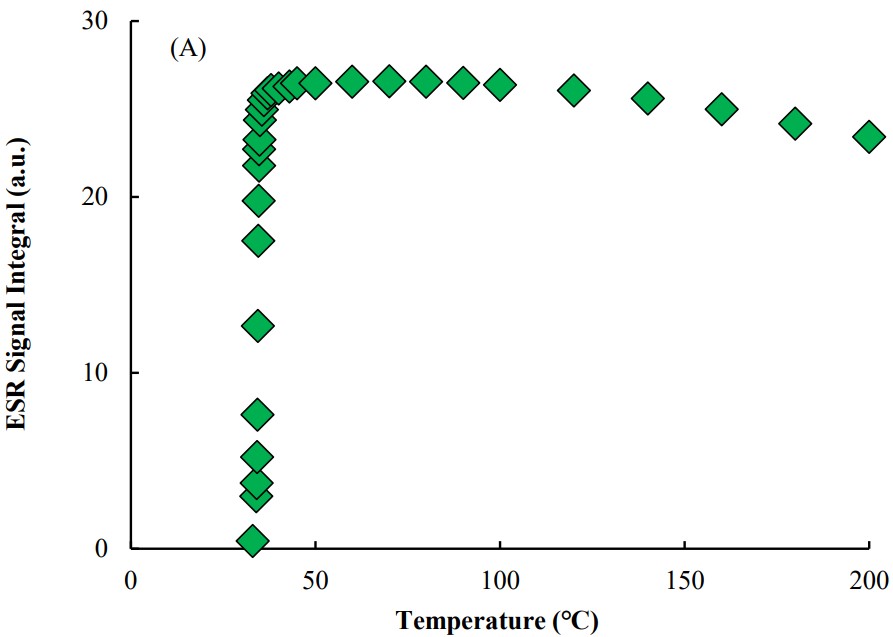
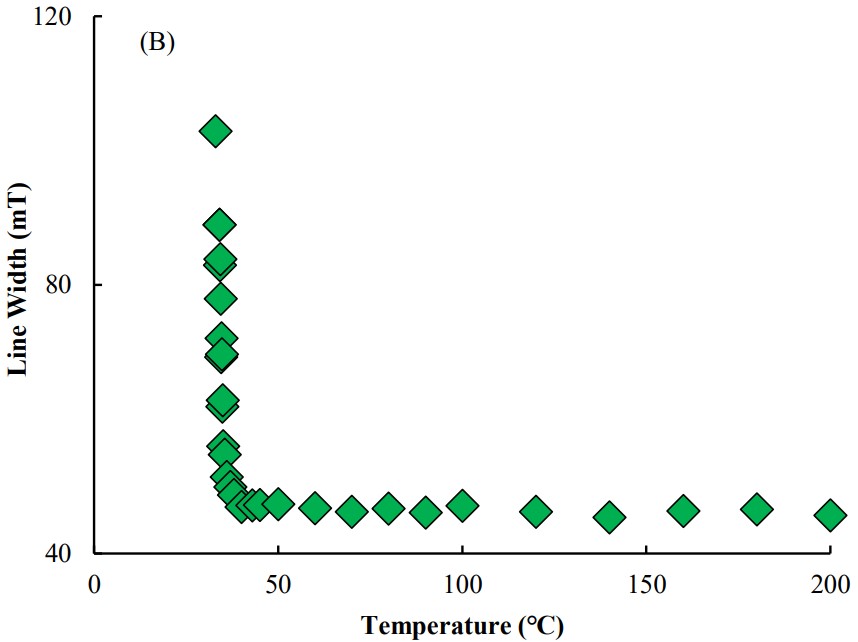
Figure 2. Temperature dependence of integral value and line width of ESR signal of chromium(III)
Reference
[1] V.G.ANUFRIEV (1977) : EPR of Cr2O3 in the phase transition region, Physics Letters A, Vol.64, 1, 139-140.
Solutions by field
Electrical / Electronic Component
Related products


Are you a medical professional or personnel engaged in medical care?
No
Please be reminded that these pages are not intended to provide the general public with information about the products.