


msFineAnalysis iQ Ver.2 Target Analysis Example Ⅲ
Analysis of Beany Odor Compounds in Soy-Based Meat Products by Microchamber and Thermal Desorption GC-MS
MSTips No. 505
1. Introduction
One of the challenges of plant-based meat alternatives is replicating the flavor of animal-based meat, and aroma plays a significant role in that flavor. In particular, reducing the beany odor is a challenge in soy-based meat products, and it is important to identify the trace compounds responsible for this odor in the aroma components of the samples. Thermal desorption (TD)-GC-MS is an analytical method used for analyzing food aroma components. Although the method enables highly sensitive and comprehensive analysis of aroma compounds in samples, searching for specific target compounds among the many detected components can be time-consuming.
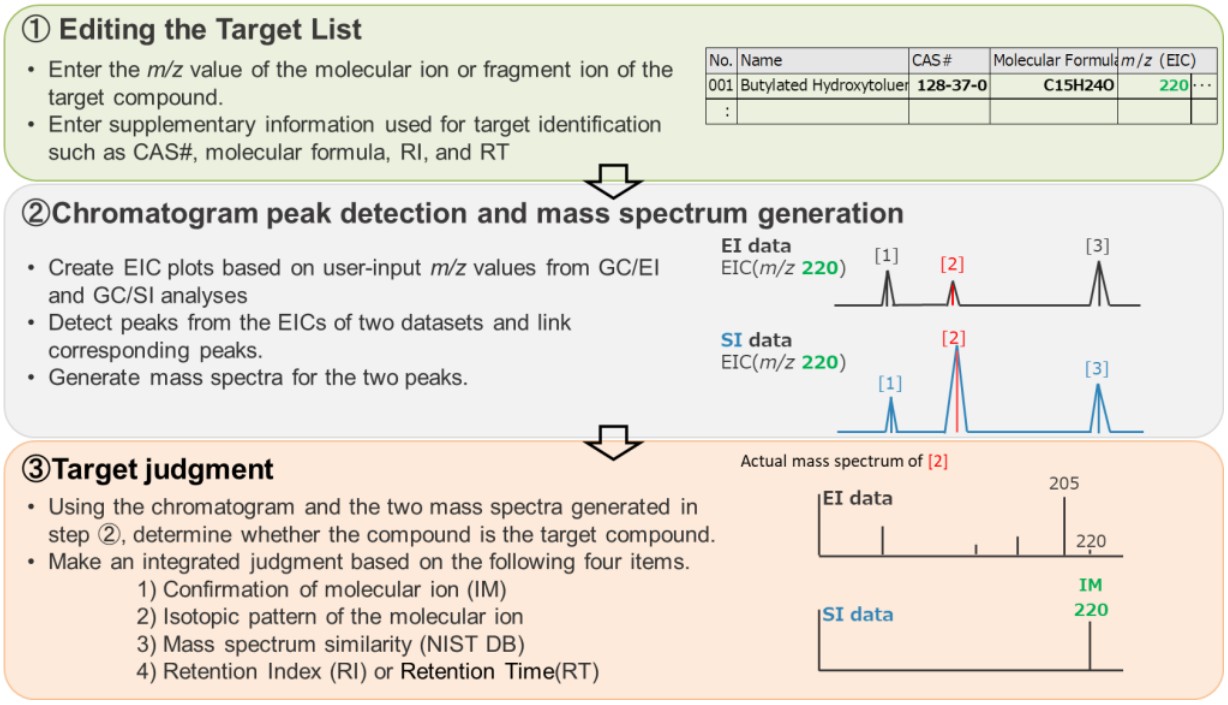
Target Analysis function on the msFineAnalysis iQ is a method for fast and accurate search and evaluation of only the target compounds based on integrated qualitative analysis1) with EI and Soft Ionization (SI) data. In this function, it is necessary to register the CAS RN® or molecular formula (or molecular weight), fragment composition formula of target compounds in the “Target List” in advance. Based on the registered information, each extracted ion chromatogram (EIC) is plotted for EI and SI measurement data and peaks are detected. The molecular ion peak in the mass spectrum, its isotopic pattern, similarity and retention index with the NIST database are confirmed about the detected peak to determine whether it is the target compound. This time, we analyzed the aroma components of soy meat products using the TD-GC-MS and rapidly identified only soybean odor components through Target Analysis.
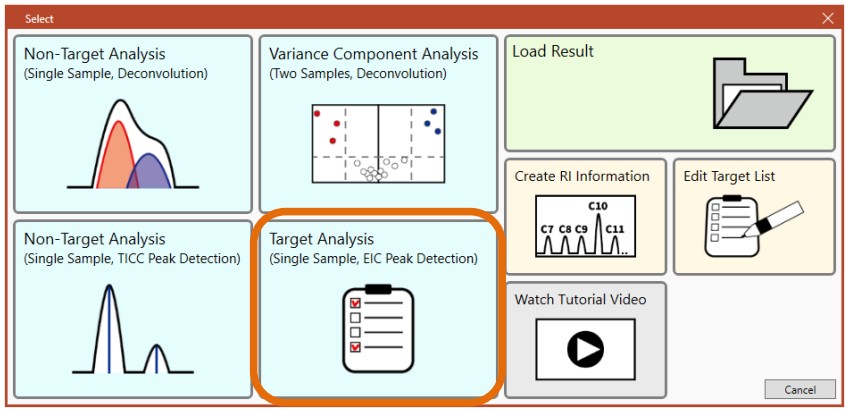
Integrated qualitative analysis software msFineAnalysis iQ Ver.2
Target Analysis flow
2. Experiment
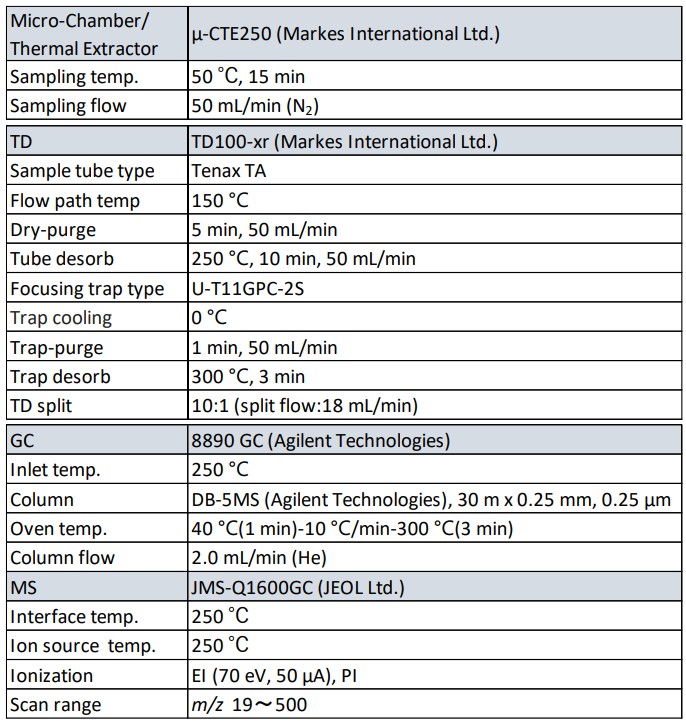
A commercial soy meat product (hamburger steak) weighing 10 g was used as a sample. The volatile compounds were extracted using a microchamber (µ-CTE250, MARKES International Ltd.) and measured using GC-MS (JMS-Q1600GC, JEOL Ltd.) equipped with TD pre-treatment device (TD-Xr100, MARKES International Ltd.). The ionization methods used were EI and PI as SI. The data obtained were analyzed using the "Target Analysis" function in the integrated qualitative analysis software “msFineAnalysis iQ”. The measurement conditions are shown in Table 1.
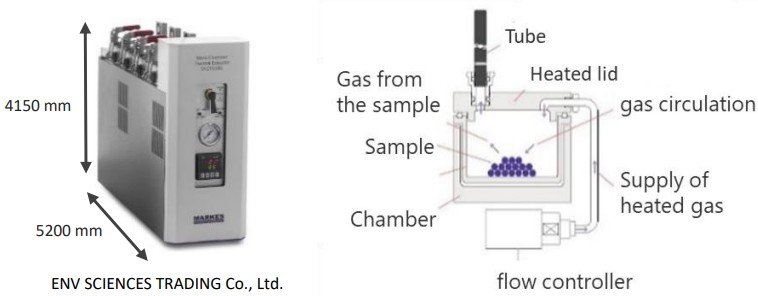
µ-CTE250
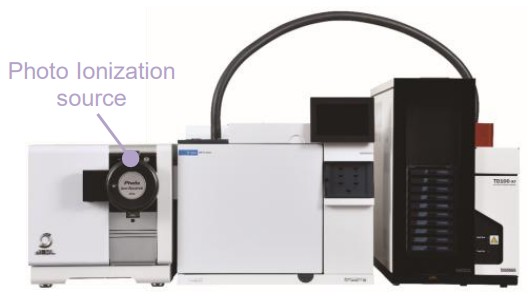
TD100-Xr,
JMS-Q1600GC UltraQuad™ SQ-Zeta
Table 1 Measurement Condition
3. Results
3.1 Nontarget analysis
The TICC of TD-GCMS measurement data is shown in Figure 1. Major peaks such as dimethyl disulfide from onion, 4-terpineol from nutmeg (basic seasonings of a Hamburger steak) were detected. Therefore, it was shown that the analysis of aroma compounds in soy-meet products is possible by using TD-GC-MS. For details, see MSTips 504.
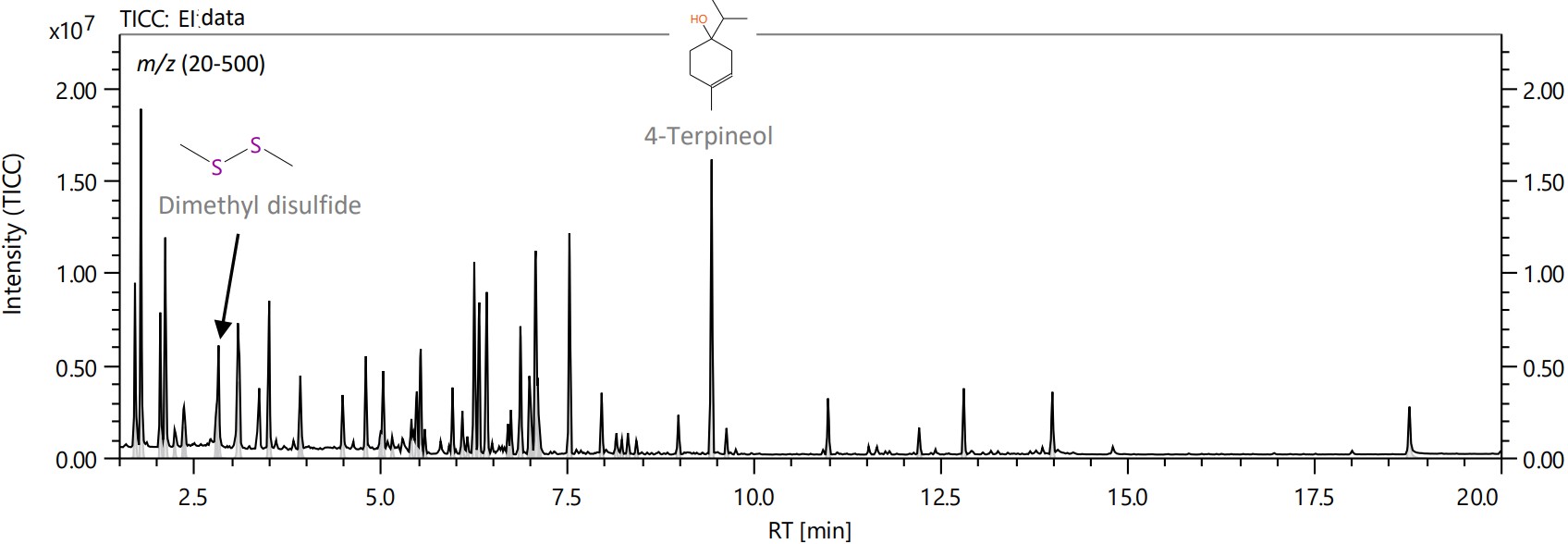
Figure 1 EI/TIC chromatogram
3.2 Editing the target list
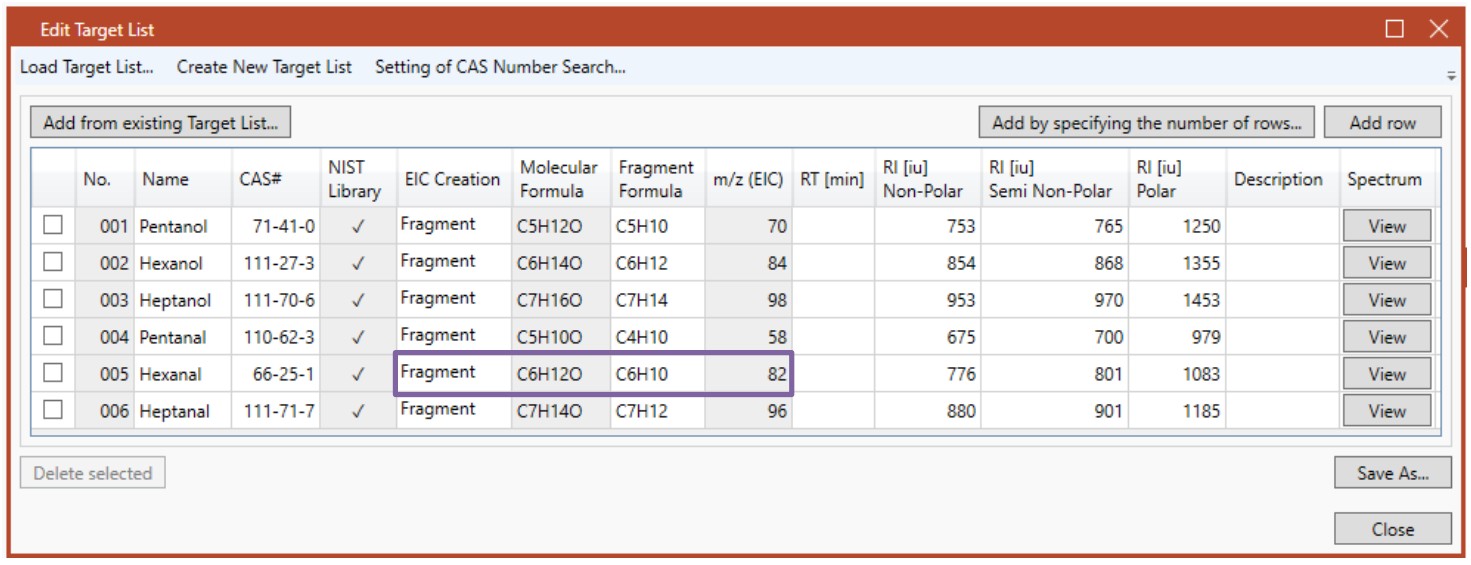
Table 2 shows a target list with six compounds known to contribute to the soybean odor. In Target Analysis, compounds can be searched using information such as molecular formula, fragment formula, or m/z value. In this study, the mass spectra of the 5 registered compounds without Pentanal have dehydration (-H₂O) ions as characteristic fragment ions. The fragment ion for Pentanal is generated by loss of CO. Therefore, fragment formula information was used to search for the compounds. This shows that Target Analysis can detect compounds even if molecular ions are not found in the mass spectra.
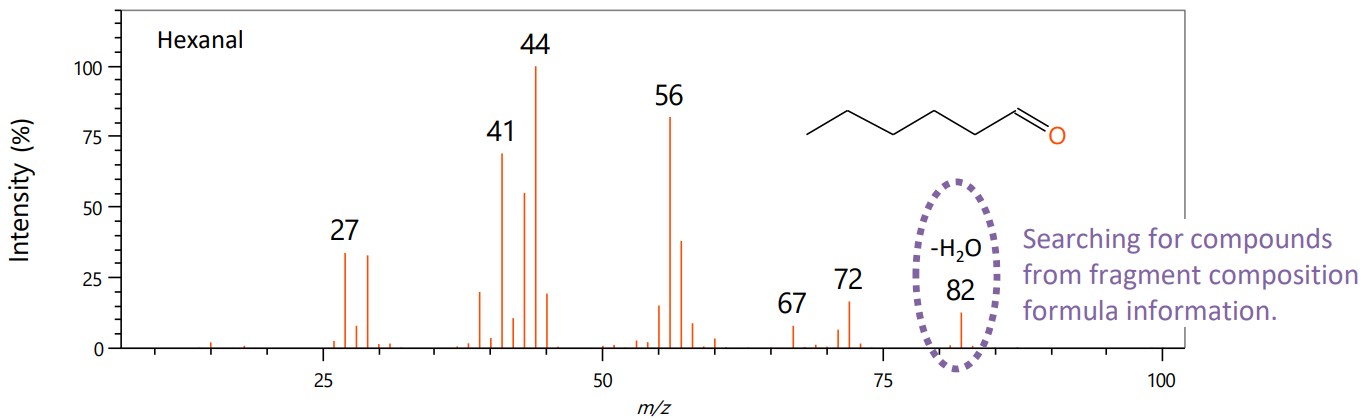
Table 2 Target List
3.3 Target Analysis Results of Soybean Odor Compounds
Figure 2 shows the results of Target Analysis. The presence of pentanol, hexanol, pentanal, hexanal, and heptanal was confirmed from the target information shown in the lower-left section of the figure (blue background). To search for the selected compound [T005] Hexanal, m/z value of 82 was registered in the target list. A candidate compound peak was detected in the extracted ion chromatogram (EIC, m/z 82) of both EI and SI data. Figure 3 shows the result of Target Judgment for the peak at RT 3.49 min (▼). The presence of the target compound was judged by the following results. First, the spectrum similarity score (maximum 999) was 892. Next, the difference between the measured RI value and the database RI value (ΔRI: within ±30 is acceptable) was -6 [iu]. Finally, the isotope matching score (Max 1.00) of molecular ion between the measured and theoretical values was 0.70. All results met the criteria. However, although the molecular ion peak of hexanal was not detected, it is known that the intensity is low. Therefore, Target Judgement (□) was manually changed to [OK] in this case. From the above, it was confirmed that hexanal was detected at RT 3.49 min.
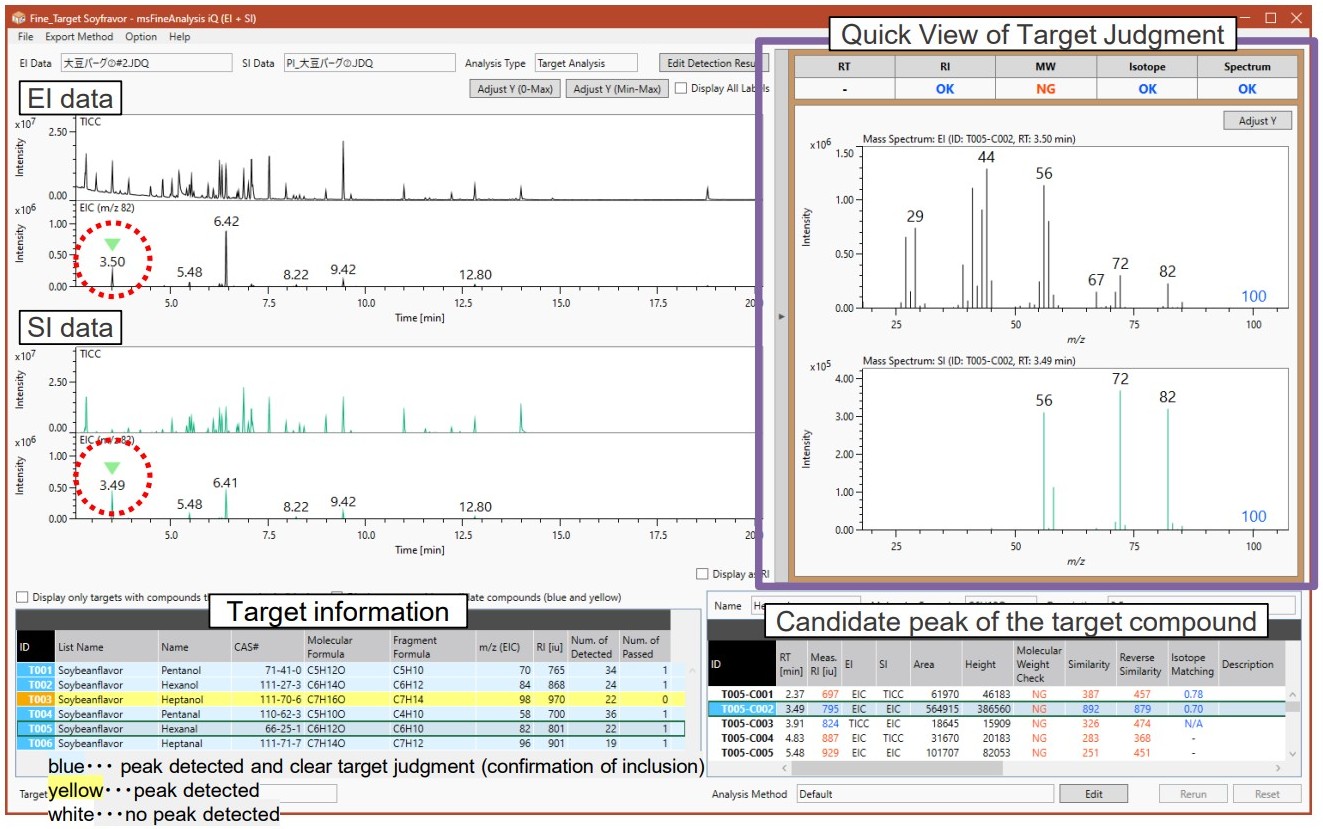
Figure 2 Result of Target Analysis
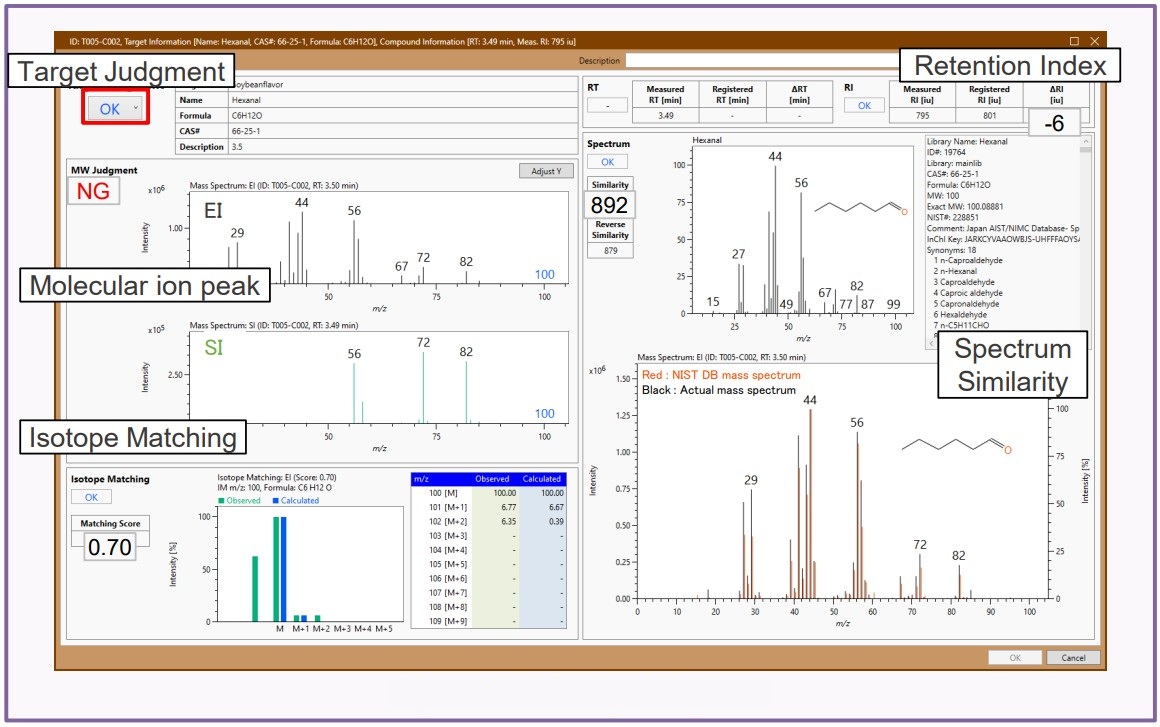
Figure 3 Result of Target Judgment
Conclusion
Using the TD-GC-MS method, we measured the aroma components of soy meat products and performed Target Analysis function to search for soybean odor compounds. As a result, the presence of soybean odor components such as hexanal and heptanal was rapidly confirmed. This report shows that Target Analysis can rapid and accurately identify specific compounds.
References
1) M. Ubukata et al, Rapid Commun Mass Spectrum., 34 (2020). DOI: 10.1002/rcm.8820
Solutions by field
Related products
Related information


Are you a medical professional or personnel engaged in medical care?
No
Please be reminded that these pages are not intended to provide the general public with information about the products.