


Joint research by Shimane University, JEOL Ltd., and collaborators has been published in “Acta Materialia”
Release Date: 2026/08/07
A joint research paper by Shimane University, Hiroshima Institute of Technology, JEOL Ltd., Kitano Seiki Co., Ltd., the National Institutes for Quantum Science and Technology (QST), the United Kingdom Atomic Energy Authority (UKAEA), the University of Oxford, and The University of Osaka has been published in “Acta Materialia”, an international journal in the field of materials science. The project was led by Shimane University.
The research group of Dr. Takahito Inoue of the Graduate School of Natural Science and Technology, Shimane University (a doctoral student at the time of the research; currently with Nippon Steel Corporation) and Professor Kazuto Arakawa of the Next Generation TATARA Co-Creation Centre (NEXTA), Shimane University, and the Research Center for Ultra-High Voltage Electron Microscopy, The University of Osaka, has directly observed the individual interactions between a gliding dislocation (1/2⟨111⟩ screw dislocation) and a nanoscale radiation defect (interstitial-type ⟨100⟩ dislocation loop) in high-purity α-iron under tensile deformation, at an elevated temperature (840 K) as well as at room temperature (300 K). The observations were carried out by in situ tensile deformation transmission electron microscopy (TEM), in which the specimen is imaged in real time while being deformed inside the microscope. The observed interactions were classified into five reaction types in terms of the loop transformation. Crucially, the resistance offered by a loop to dislocation glide is higher at the elevated temperature. This contradicts the traditional notion of obstacle strength, under which the resistance by defects and precipitates to dislocation glide is assumed to decrease with increasing temperature. These findings provide important insights for interpreting the high-temperature mechanical degradation of irradiated ferritic steels for nuclear fission and fusion applications.
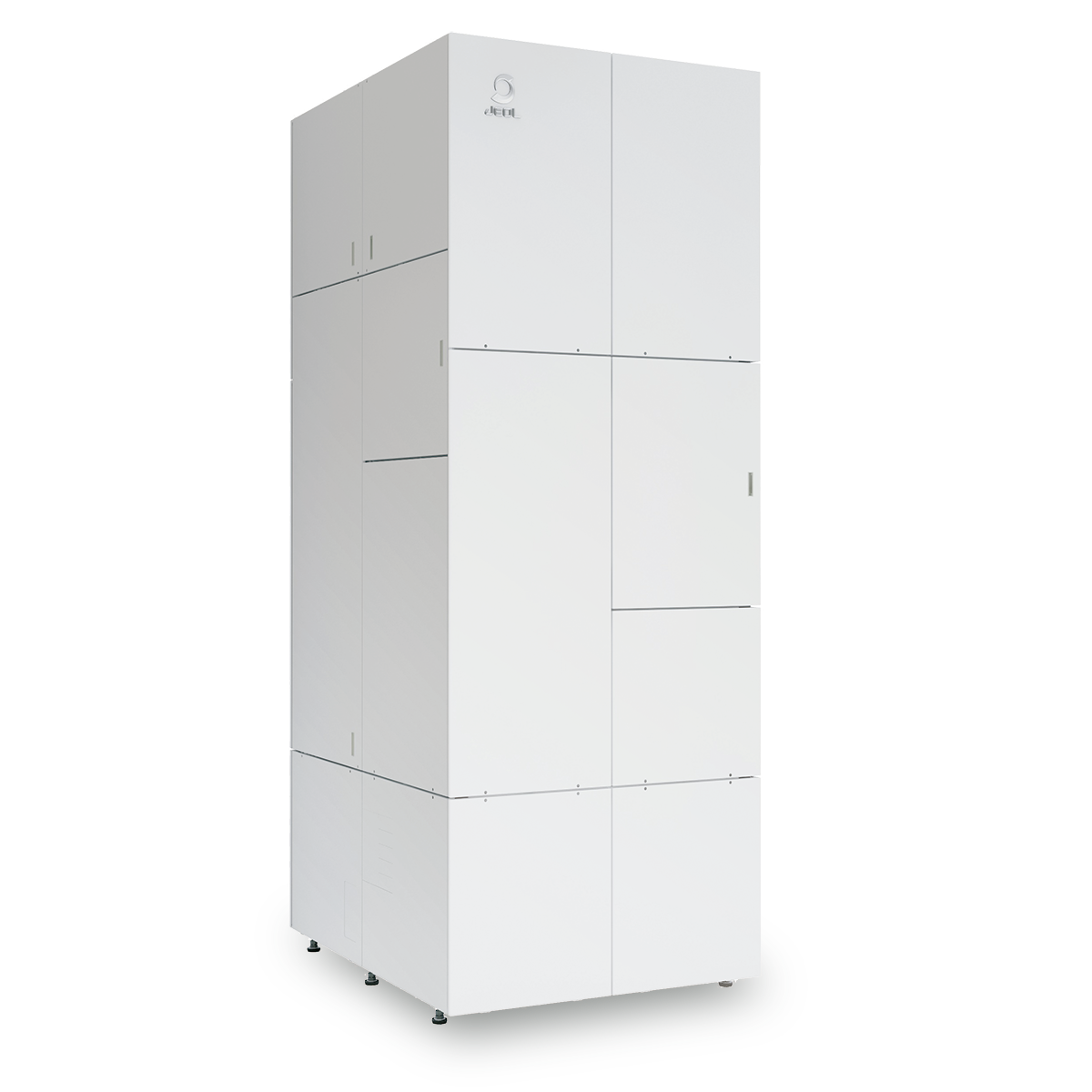
The in situ observations at room temperature were performed using the magnetic field-free electron microscope “JEM-Z200MF” (Magnetic field-free Atomic Resolution imaging System: MARS), which was developed by JEOL and is installed at Shimane University. Since iron is ferromagnetic, the strong magnetic field of the objective lens in a conventional TEM exerts a force on the specimen and deflects the electron beam, making clear in situ observation difficult. The JEM-Z200MF, which provides an essentially magnetic field-free environment at the specimen position, contributed to the realization of this achievement. In addition, this paper includes Dr. Tatsuhiro Maekawa of JEOL as a co-author.
Direct in situ transmission electron microscopy observation of the interaction between gliding 1/2⟨111⟩ screw dislocations and ⟨100⟩ prismatic dislocation loops in α-iron
Related Products


Are you a medical professional or personnel engaged in medical care?
No
Please be reminded that these pages are not intended to provide the general public with information about the products.