


Transition to Pb-Free Free-Machining Brass
Rapid determination of alloy type and response to contamination from different materials
EQ2026-01
Introduction
Previously, the RoHS directive permitted up to 4 wt% of lead (Pb) in copper (Cu) alloys, but from July 2027, its use will be prohibited, requiring replacement with Pb-free free-machining brass.
The alternative materials are copper alloys with added bismuth (C6801) and copper alloys with added silicon (C6932).
By using the JSX-1000S, even silicon (Si), which is difficult to
detect in the atmosphere, can be detected in 30 seconds, making it possible to non-destructively and quickly determine the type of copper alloy (Pb, Si, or Bi).
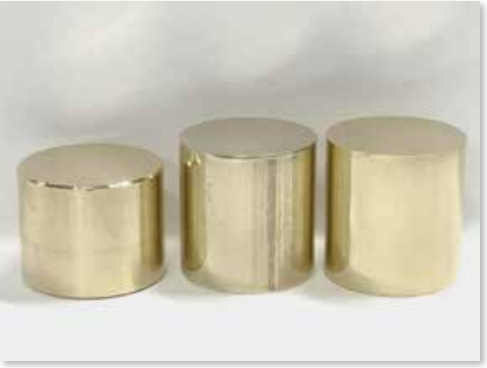
XRF measurement results (in the atmosphere for 30 seconds)
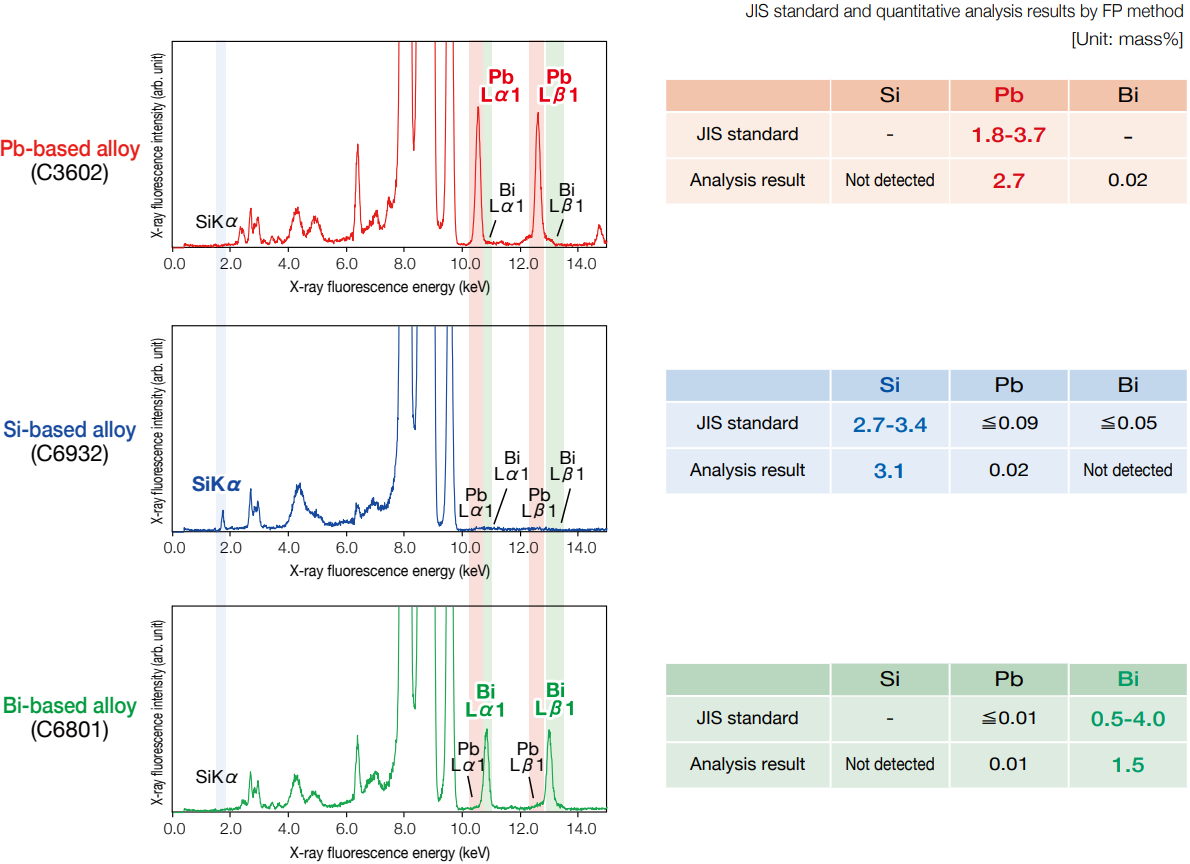
The type of Pb-free Cu alloy can be determined by measurement in the atmosphere in just 30 seconds.
In addition, the analysis can be done easily and quickly with simple analysis solutions and QBase software.
Note: QBase is an abbreviation of Qualitative Analysis Database.
Simple Analysis Solution button
RoHS-Compliant Pb Screening for Bi-Added Free-Machining Brass (C6801 Series)
Previously, the RoHS directive permitted up to 4 wt% of Pb in Cu alloys. However, due to the spread of Pb-free Bi added free-machining brass (C6801), RoHS screening for Pb-free free-machining brass will be required from July 2027 onwards. In C6801-series Cu alloys, Pb peaks overlap with co-existing element peaks such as bismuth (Bi), arsenic (As) and selenium (Se), making it difficult to determine the presence of Pb peaks. Therefore, it is difficult to perform accurate screening with the calibration curve method, which specifies ROI and calculates the peak intensity.
The FP method of the JSX-1000S does not quantitatively calculate only the main peaks of fluorescent X-ray, such as the Kα line and the Lα line, but the intensity is calculated using all peaks in the series such as the K series (Kα and Kβ lines) and L series (Lα , Lβ and Lγ lines), and the quantitative calculation is performed. As a result, even if the peak of Pb overlaps with the peaks of coexisting elements, analytical values with reduced variation can be obtained.
An example of analysis using a standard sample MBH CRM 32XSEB4 F is shown below.
Note: RoHS Directive 2011/65/EU, Annex III 6(c)
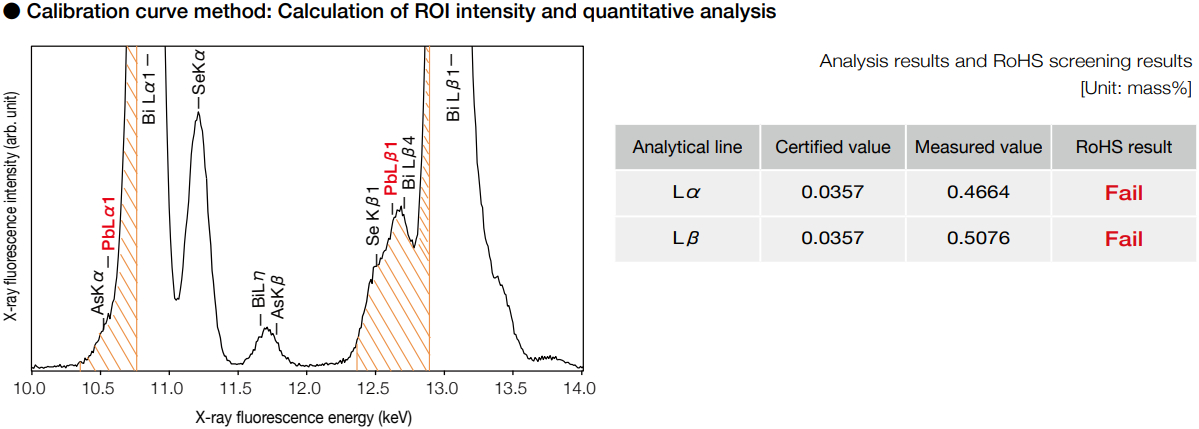
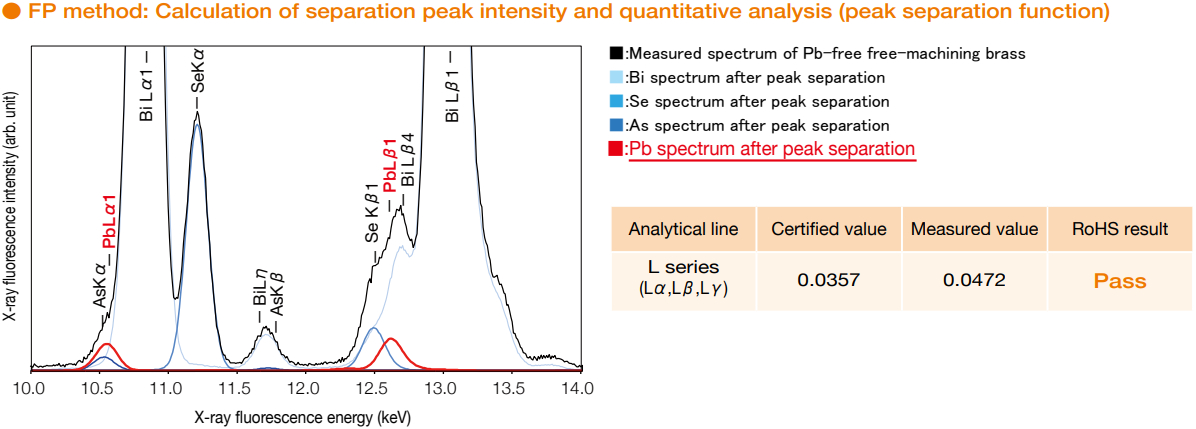
In the FP method of the JSX-1000S, even if the main peaks overlap, the peak separation is performed before quantitative calculation, so the quantitative results can be obtained more accurately.
In addition, the analysis can be done easily and quickly with RoHS Auto and RoHS Metal solutions.
RoHS solution button
Solutions by field
Electrical / Electronic Component
Related products


Are you a medical professional or personnel engaged in medical care?
No
Please be reminded that these pages are not intended to provide the general public with information about the products.