


Advancing Welding and Joining Technologies in the ASEAN Region: The Joining & Welding Research Institute HUST-UOsaka
Materials Characterization and Human Resource Development Using Electron Microscopy
The Joining & Welding Research Institute HUST-UOsaka, established through collaboration between the School of Mechanical Engineering at Hanoi University of Science and Technology (HUST) and the Joining & Welding Research Institute (JWRI) at the University of Osaka, is dedicated to research and education in welding and joining technologies in Vietnam and throughout the ASEAN region.
At the institute, research is conducted on a variety of welding processes, including plasma welding, laser welding, and friction stir welding (FSW). These studies focus on physical evaluation of welded joints, microstructural observation, and metallurgical transformations.
The institute also contributes to technical workforce development and technological innovation across the ASEAN region, promoting research and education through close collaboration between academia and industry.
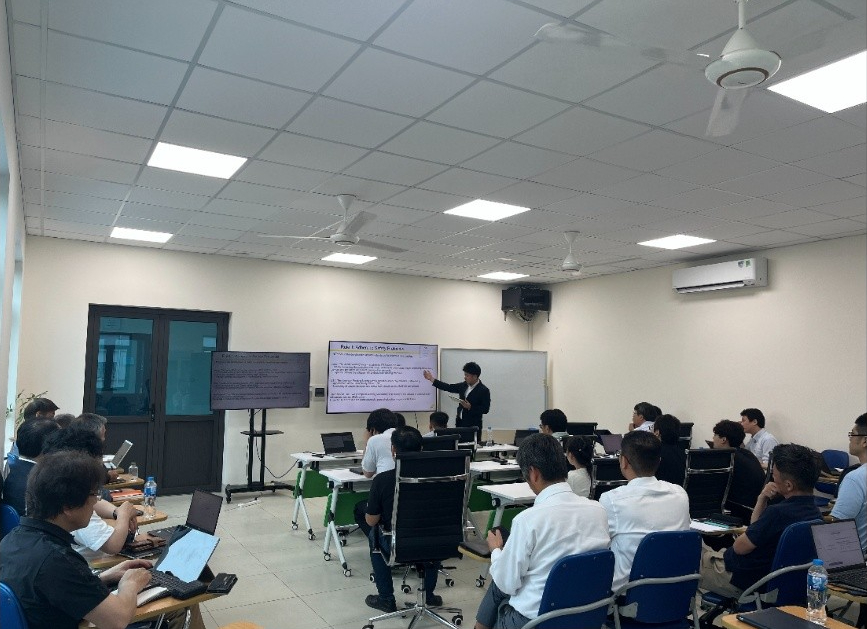
Vietnam Welding Research Group Meeting
Understanding microstructural changes occurring in welded and joined materials is essential for advancing welding and joining technologies. One of the key instruments supporting this research is the JSM-IT800 field emission scanning electron microscope (FE-SEM) manufactured by JEOL Ltd.
In this article, we introduce materials characterization activities at the institute and highlight its use of the JSM-IT800.
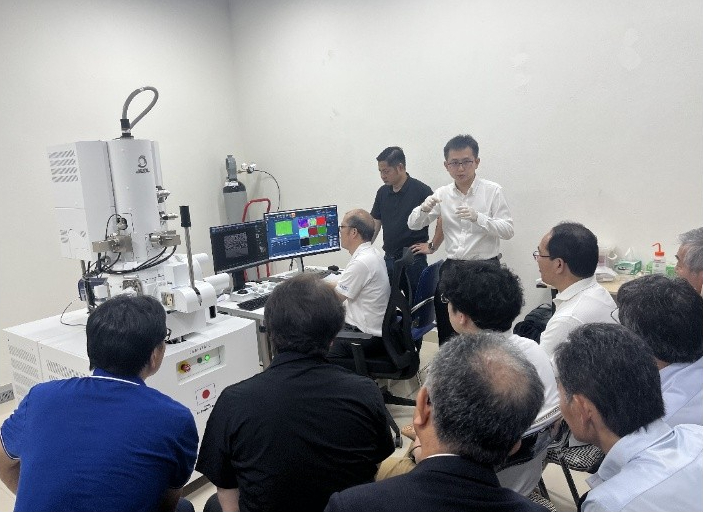
Live Demonstration of the JSM-IT800 at JWRI HUST-UOsaka
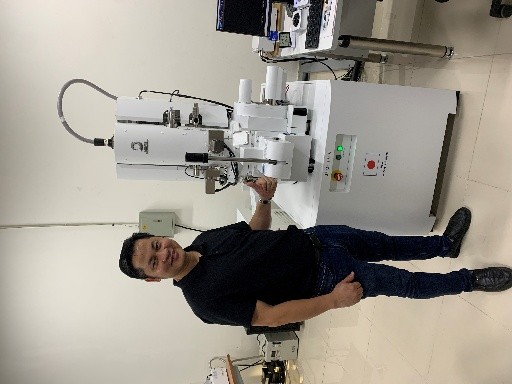
Dr. Han Le Duy Vice Director, JWRI HUST-UOsaka
Materials Characterization Supporting Welding and Joining Research
At the institute, a wide range of materials characterization activities are conducted to understand the relationship between microstructural changes and material properties resulting from welding and joining processes.
In welding and joining research, it is not sufficient to evaluate only the strength of a joint. Researchers must comprehensively understand the relationships among processes, microstructure, properties, and performance.
The microstructure of welded parts, particularly within the heat-affected zone (HAZ), has a significant influence on the final properties of materials. Therefore, microstructural observation and analysis using SEM constitute one of the institute's major research activities.
"Materials characterization occupies a fundamental and central role in welding and joining research."
Understanding Welding Phenomena Through Microstructural Analysis
At the institute, SEM is primarily used for observing the microstructure of metals.
When evaluating welded joints, information such as grain size, crystal orientation, and strain distribution is critical. To obtain such microstructural information, the institute employs Electron Backscatter Diffraction (EBSD) for crystallographic orientation analysis.
In cases where elemental distribution influences mechanical properties, Energy Dispersive X-ray Spectroscopy (EDS) mapping is conducted to evaluate its relationship with microstructure and strain distribution.
"We perform crystallographic orientation analysis using EBSD and compare the results with elemental maps obtained by EDS to investigate the microstructure and the origins of strain distribution."
By integrating information obtained from SEM, EBSD, and EDS, the institute seeks to elucidate the formation mechanisms of complex weld structures.
Achieving Deeper Understanding of Complex Weld Microstructures
The institute utilizes the JEOL JSM-IT800 FE-SEM for microstructural observation, elemental analysis, and crystallographic orientation analysis of welded materials.
"The introduction of the JSM-IT800 has greatly simplified and improved our workflow. Compared with our previous system, it provides clearer images, more stable performance, and faster analysis."
The institute's objective is to understand the relationship between welding-induced microstructures and material properties. Since adopting the JSM-IT800, researchers have been able to observe finer microstructural features and obtain higher-quality EBSD data, enabling more detailed analysis of complex weld structures.
"We are now able to gain a deeper understanding of the relationships among welding processes, microstructures, and material properties."
For researchers, the objective is not merely to observe and analyze materials, but to use the acquired data to uncover the fundamental mechanisms of welding phenomena and understand their relationship to material properties. The JSM-IT800 serves as a key research platform for this purpose.
High-Quality Analytical Data Supporting Research
One of the most significant benefits of introducing the JSM-IT800 has been the improvement in data quality.
"The greatest improvement has been the quality of the data. We can now observe finer structures and obtain more accurate elemental maps and higher-quality EBSD data."
The enhanced capabilities of the JSM-IT800 allow the institute to perform more detailed microstructural observation and EBSD analysis than ever before. As a result, researchers can analyze complex weld microstructures with greater accuracy and confidence in their findings.
Supporting Both Research and Education
At the institute, the JSM-IT800 is used not only for research but also as an educational tool.
Students learn materials characterization techniques and data analysis methodologies through hands-on experience with SEM observation and EBSD analysis using the instrument.
"Students have opportunities to use advanced SEM and EBSD systems and learn how to analyze real research data."
The JSM-IT800 is also shared with research groups in chemistry, materials science, metallurgy, and related fields, where it supports collaborative research involving many faculty members and graduate students.
Thus, the instrument functions not only as a powerful analytical system supporting research activities but also as an important educational facility for training the next generation of researchers and engineers.
JEOL Support for Sustainable Research Activities
The institute utilizes JEOL's technical support to ensure the smooth operation of the JSM-IT800.
"JEOL staff visit us frequently and provide support that feels truly close at hand. They have also supported workshops and observation sessions, assisting not only with technical matters but also with planning events that utilize the instrument."
In addition to technical assistance, JEOL supports activities that promote effective use of the instrument, helping to create an environment that sustains long-term research efforts. In modern research environments, reliable support infrastructure is just as important as instrument performance itself.
Advancing Welding and Joining Technologies Through Research and Education
As research into advanced materials and manufacturing technologies continues to expand, the importance of microstructural characterization is expected to grow even further.
"SEM and EBSD are valuable tools for understanding the relationships among processing, microstructure, crystal structure, defects, and material properties. They also provide valuable data for simulations, digital materials research, and AI-assisted materials development."
The institute advances research in welding and joining using the JSM-IT800 while promoting the development of regional welding and joining technologies through engineer training and technology development.
Secretariat
Vietnam Welding Research Club,
Joining & Welding Research Institute,
The University of Osaka, Vietnam Office
(JWRI Hub at HUST)
| Address | No. 3, Ngo 15, Ta Quang Buu Street, Bach Khoa, Bach Mai, Hanoi |
|---|---|
| katsumata.mihoko.jwri#osaka-u.ac.jp (Replace "#" with "@" when sending.) |
|
| Contact Person | Mihoko Katsumata, Associate Professor, Joining & Welding Research Institute, The University of Osaka Dr. Han Le Duy, Lecturer at Hanoi University of Science and Technology (HUST); Vice Director, Joining & Welding Research Institute HUST-UOsaka |