


Stress Measurement and SEM Observation of NMC Particles during In-Situ Nanoindentation
SM2026-01
Introduction
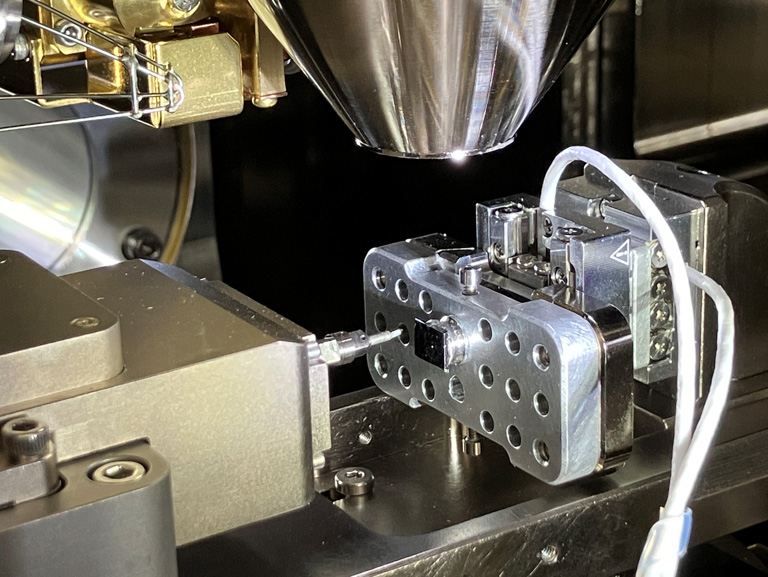
Fig.1 Appearance of the nanoindenter mounted on the specimen stage of the JSM-IT810
In battery materials research, there is a need to evaluate the microstructure and crack behaviors of NMC particles used in cathode materials. Since localized stresses are applied to the particles during the roll press (calendering) process and the charge-discharge cycle, it is important to understand their mechanical properties at the particle level. By combining SEM, which allows for the observation of microstructure, with in-situ nanoindentation, which enables real-time evaluation of a particle’s mechanical response under load, it is possible to directly measure mechanical properties at the particle level. This application note presents a case study evaluating the crack formation and propagation behavior, as well as particle size dependence, of NMC811 particles using in-situ nanoindentation within an SEM.
Experimental Setup
Instrument Configuration
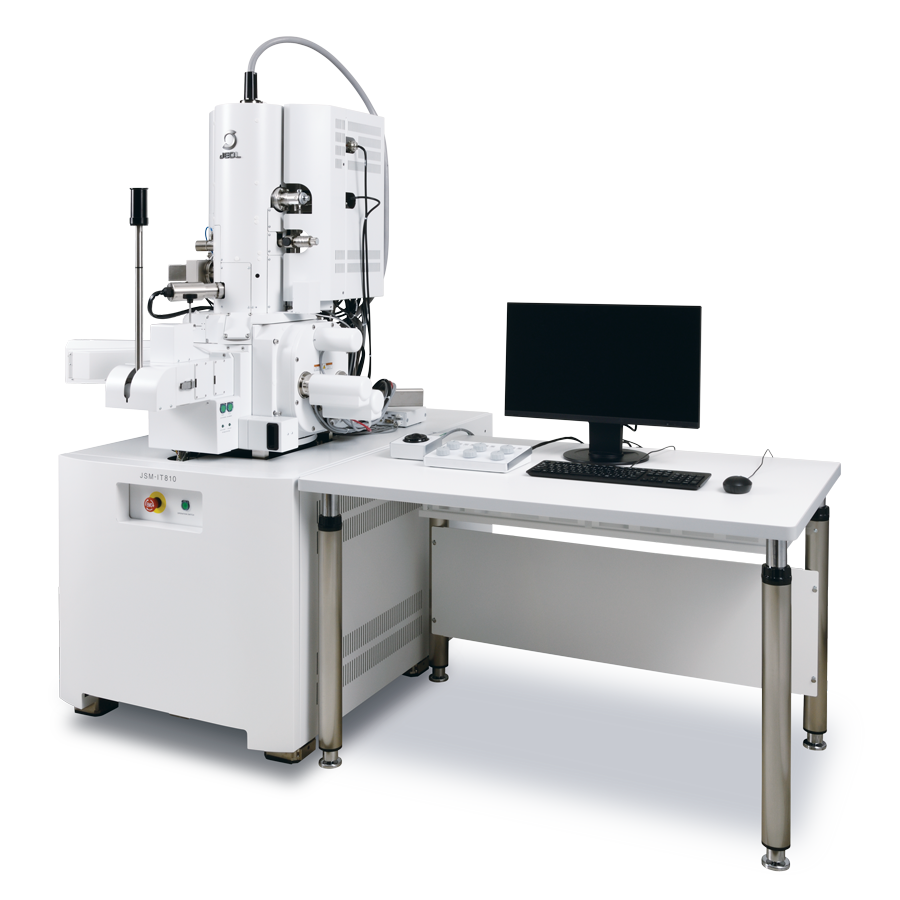
- SEM: JSM-IT810SHL (JEOL)
- Nanoindenter: Hysitron PI Envision SEM PicoIndenter (Bruker)
- Probe: Flat-end Diamond Indenter (20 µm in diameter)
- EBSD: Velocity Ultra (EDAX)
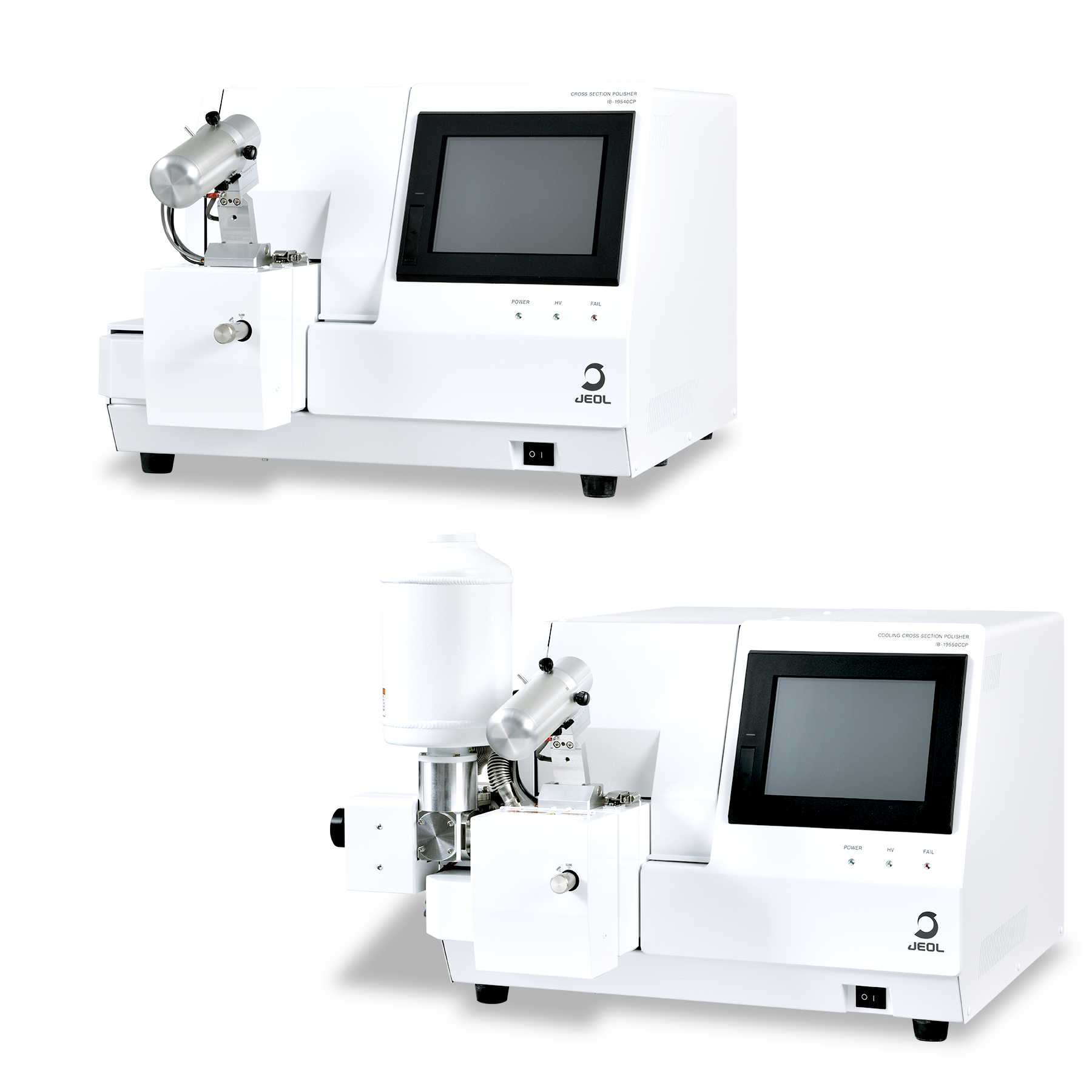
- CP: IB-19540CP (JEOL)
Sample Preparation
- Unused polycrystalline NMC811 particles were dispersed in ethanol, dropped onto a silicon substrate, and then dried.
NMC Particles Compression Test Results
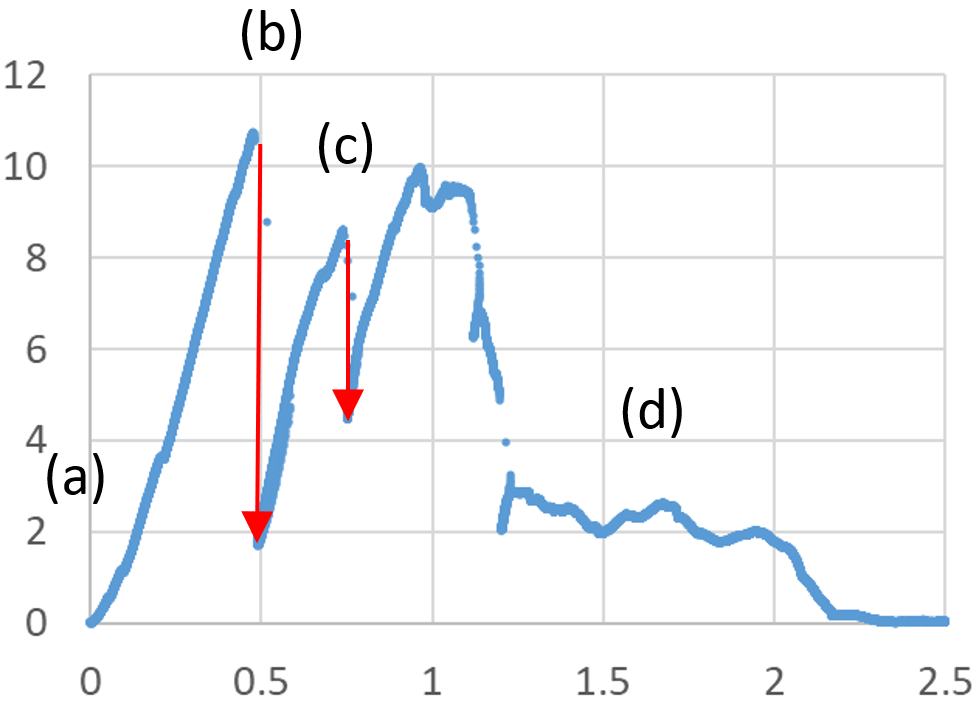
The results of compression tests on randomly distributed NMC particles on a silicon substrate, conducted at a compression rate of 20 nm/s, are shown in Figs. 2 and 3. Fig. 2 (a) to (d) are SEM images taken from before the start of the compression test until destruction occurs due to compression. Fig. 3 shows the load–displacement curve for this compression test, with the observation timings (a) to (d) for each SEM image indicated in the figure. Fig. (b) corresponds to the point of maximum load; as indicated by the red dotted line, a crack has formed within the compressed particle, and the stress has been relieved. In (c), even after the stress was initially relieved, compression by the indenter continued, and stress relief occurred again as the crack propagated. The crack propagated along the grain boundaries, and it was confirmed that grain boundary fracture was dominant. The formation and propagation of cracks continued thereafter, and ultimately, as shown in (d), the NMC particle was destroyed. Additionally, a video of the SEM images corresponding to (a) through (d) during the compression test was recorded.
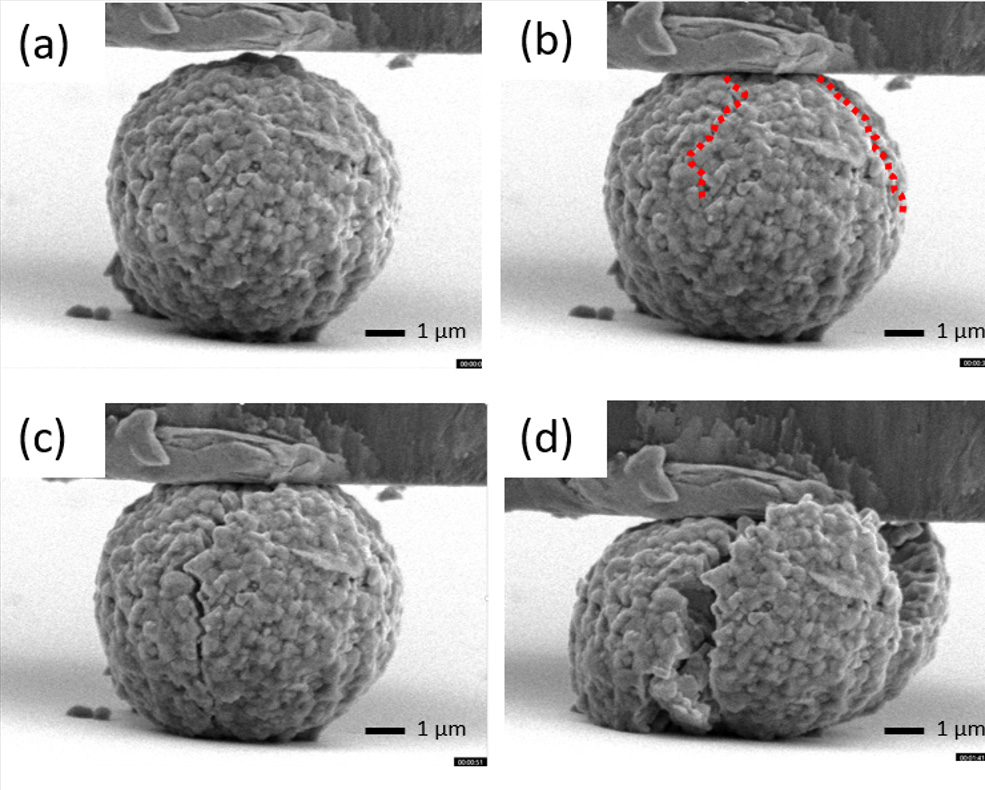
Video 1. NMC particle during compression
Relationship between NMC particle size and maximum load
Next, we examined the diameter and shape of similar NMC particles dispersed on a silicon substrate using SEM observation and measured the mechanical properties of the selected particles. We performed repeated compression tests while measuring the diameter of each secondary particle from SEM images. The results showing the relationship between secondary particle size and maximum load are shown in Fig 4. To increase number of measurements, we increased the compression speed to 100 nm/sec. For the NMC particles used in this experiment, it was confirmed that the maximum load before destruction increased as the particle size increased.
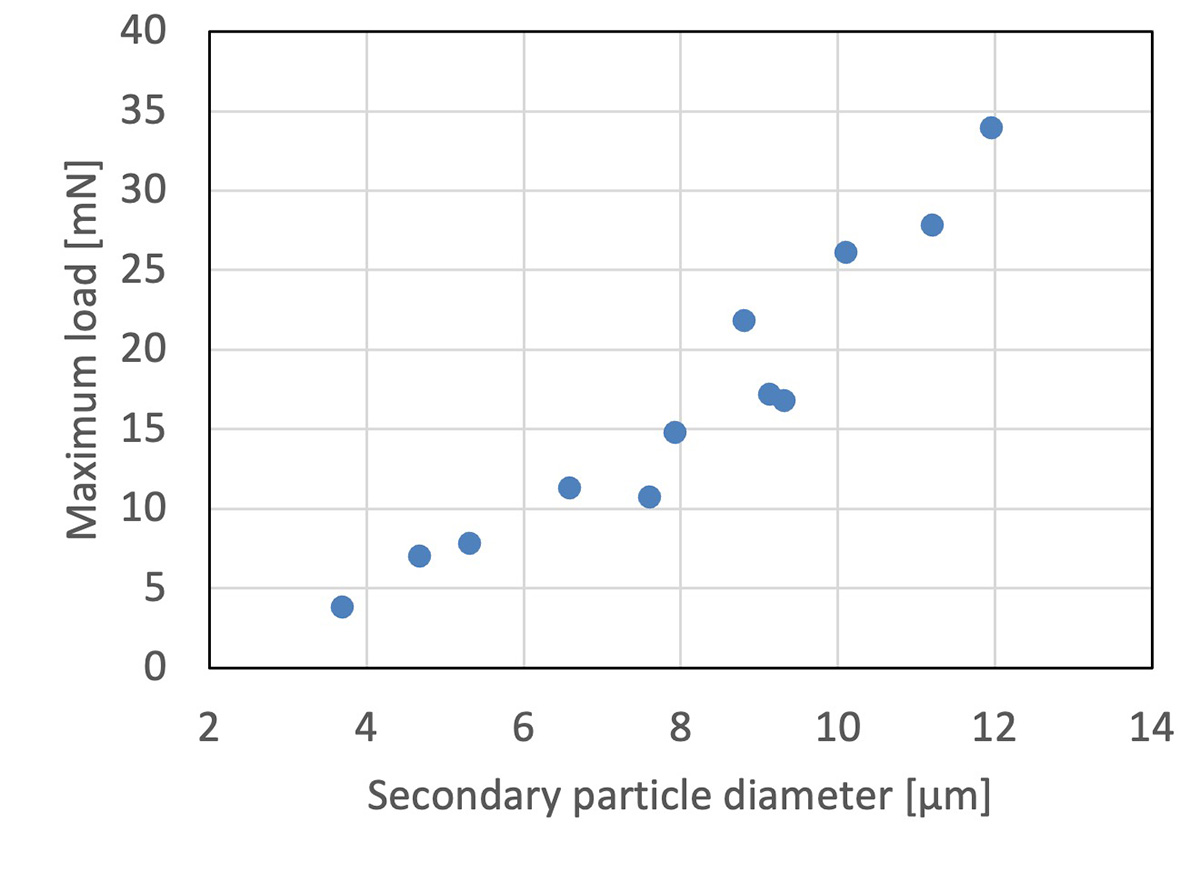
Fig. 4 Secondary particle diameter of NMC particle and maximum load properties
Internal void observation by CP processing and grain size distribution of primary grains by EBSD
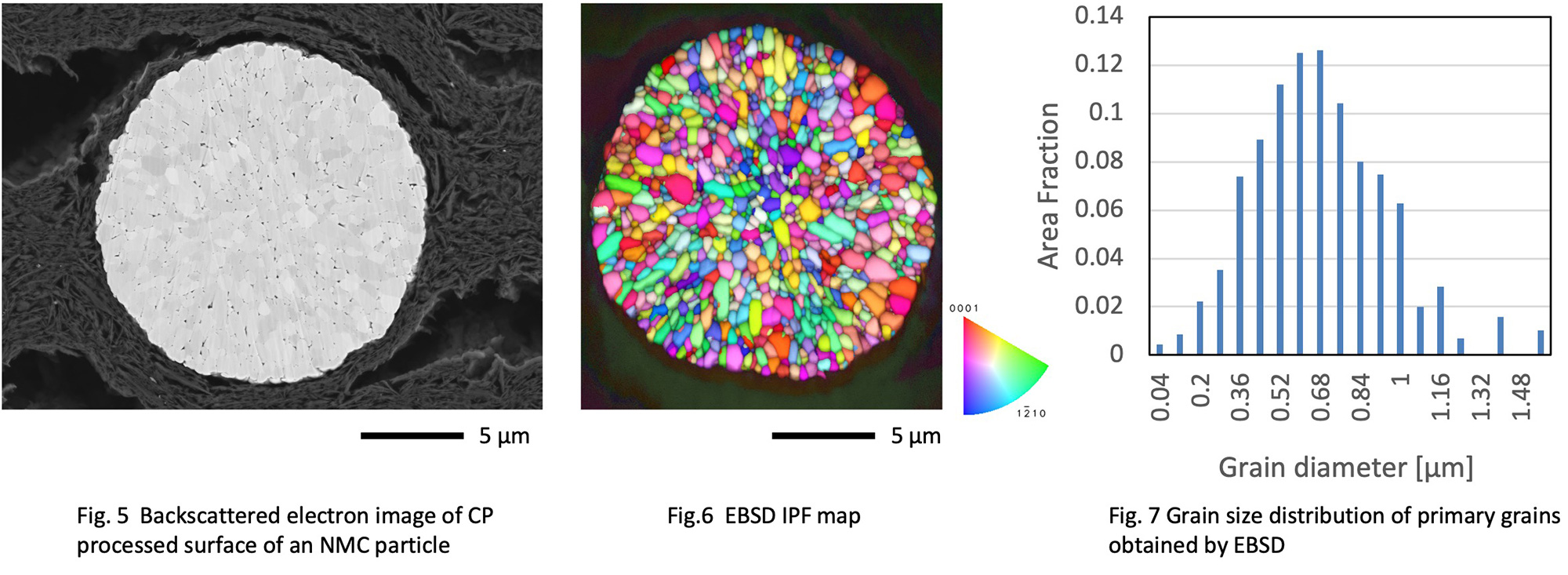
Since the mechanical properties of NMC particles are also influenced by the grain size distribution and porosity of the primary grains, evaluations were also conducted using cross-sections of the particles. NMC particles were cross-sectioned using CP to observe internal voids and measure the grain size distribution of the primary grains. Fig. 5 shows the backscattered electron image of a CP-sectioned NMC particle. The distribution of primary grains was confirmed based on the channeling contrast, and voids were observed at the primary grain boundaries. The porosity was calculated by binarizing the backscattered electron image, and the porosity of this particle was found to be 2.26%. The results of the EBSD measurements for this particle are shown in Fig. 6 and 7. The EBSD maps successfully captured the distribution of primary grains. Fig. 7 shows the grain size distribution of the primary grains calculated from the EBSD results, with an average primary grain diameter of 0.66 µm.
Conclusion
By combining in-situ nanoindentation, which allows for the evaluation of a particle’s mechanical response under load, with SEM, we directly measured the mechanical properties at the particle level. Furthermore, by incorporating the CROSS SECTION POLISHER™ and EBSD to evaluate primary particles, we confirmed that NMC particles can be analyzed and evaluated from multiple perspectives. This SEM-based approach integrating in-situ nanoindentation and EBSD measurements is expected to be applicable not only to NMC particles but also to the evaluation of mechanical properties of other cathode and anode materials.
Solutions by field
Related products


Are you a medical professional or personnel engaged in medical care?
No
Please be reminded that these pages are not intended to provide the general public with information about the products.